I’ve spent my career looking at water from the fish’s side of the glass — that’s what a master’s in Zoology does to you. So when readers started asking me how much does it cost to start biofloc farming, I didn’t answer like a business consultant. I answered like someone who’s spent years thinking about ammonia, oxygen, and what happens to an animal when either one goes wrong.
Here’s the myth that trips up almost every beginner: biofloc is not “cheap fish farming.” It’s low-water-use fish farming. Those aren’t the same thing. Skip the aeration budget to save money, and you can lose an entire tank overnight. I’ve seen the biology behind exactly why that happens, and I’ll walk you through it here — along with the real numbers.
Quick answer: Starting biofloc farming costs $1,200–$3,000 for a small 1–2 tank hobby setup, $3,800–$9,000 for a 4–6 tank medium operation, and $15,000–$50,000+ for a commercial 10+ tank farm. The single biggest hidden cost beginners underbudget for isn’t the tank — it’s backup aeration.
What Biofloc Actually Is (and Why It’s Not “Just a Tank”)
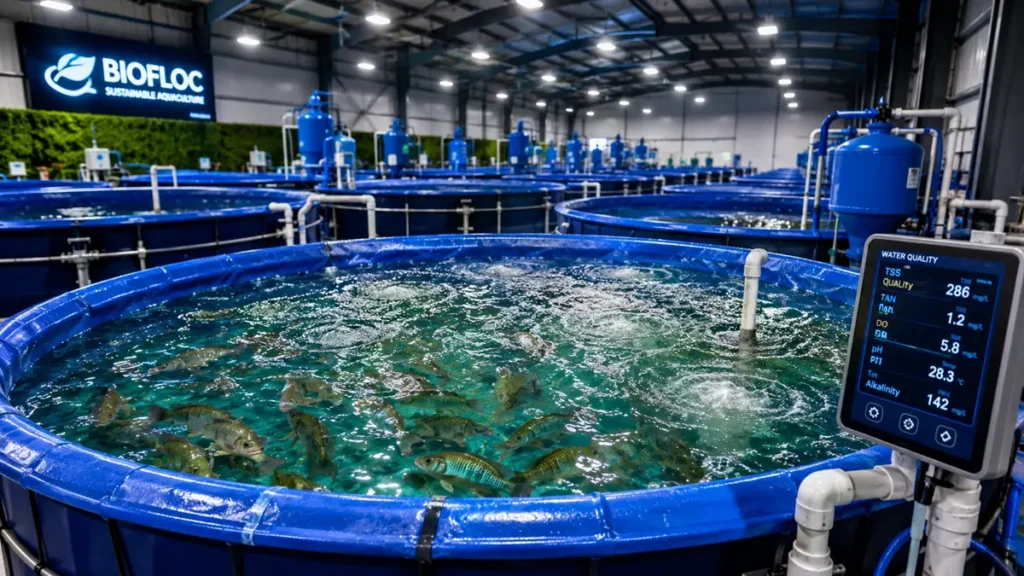
Strip away the marketing, and biofloc fish farming is a water chemistry system wearing an aquaculture costume. You’re not really farming fish first — you’re farming bacteria, and the bacteria happen to feed your fish for free.
Here’s the mechanism in plain English. Fish waste and uneaten feed break down into ammonia. Ammonia is toxic — even at low levels, it burns fish gill tissue the way ammonia fumes would irritate your own eyes. In a biofloc system, you deliberately feed carbon (molasses, tapioca flour, rice bran) to heterotrophic bacteria. Those bacteria consume the ammonia to build their own bodies, forming clumps called “floc.” The fish then eat that floc as a protein-rich snack. You’ve turned a waste problem into a feed source.
This is also why biofloc systems can hold 15–20 times more fish per liter than a traditional pond. The bacteria are doing water-treatment work that would otherwise require constant water changes.
Why Biofloc Costs Less to Start Than a Pond
- Uses tanks or liners instead of dug ponds — no excavation cost
- Up to 90% less water use, which matters if you’re on municipal water pricing
- Small footprint works on a rooftop, garage, or backyard shed
- Higher stocking density means more fish per dollar of infrastructure
- Lower long-term feed cost once floc is established
The Real Cost to Start Biofloc Farming, by Scale
There’s no single number for how much does it cost to start biofloc farming — it depends entirely on scale. Here’s the honest breakdown, based on current 2026 USD pricing.
Small-Scale Setup (1–2 Tanks) — For Testing the Waters
| Item | Cost (USD) |
| Tank (5,000–10,000 L) | $400 – $1,200 each |
| Aeration system | $250 – $600 |
| Air blowers & diffusers | $150 – $350 |
| Water pumps | $50 – $150 |
| Water testing kit | $30 – $80 |
| Probiotics & minerals | $40 – $120 |
| Fish fingerlings | $50 – $200 |
| Feed (first 2 months) | $80 – $180 |
| Electrical setup | $40 – $100 |
| Miscellaneous | $50 – $150 |
| Total | $1,200 – $3,000 |
Medium-Scale Setup (4–6 Tanks) — For Serious Side-Income
| Item | Cost (USD) |
| Tanks | $2,000 – $5,000 |
| Advanced aeration | $600 – $1,200 |
| High-efficiency pumps | $150 – $400 |
| Standby generator | $300 – $800 |
| Probiotics & inputs | $120 – $300 |
| Fingerlings | $150 – $450 |
| Feed | $200 – $500 |
| Miscellaneous | $200 – $500 |
| Total | $3,800 – $9,000 |
Commercial Farm (10+ Tanks)
Most commercial biofloc operations in the USA and Canada start with 10–20 tanks.
- Total investment: $15,000 – $50,000+
- Annual revenue potential: $80,000 – $150,000 depending on species and market access
The jump between medium and commercial isn’t just “more tanks” — it’s the point where you need a standby generator as a non-negotiable, not an optional line item. More on why in a minute.
Biofloc vs Traditional Fish Farming: Which Actually Pays Off
If you’re weighing biofloc vs traditional fish farming, the comparison isn’t close on startup cost — but traditional farming still wins on a few fronts worth knowing before you commit.
| Factor | Biofloc Fish Farming | Traditional Fish Farming |
| Startup cost (USA) | $1,200 – $50,000 | $25,000 – $200,000 |
| Water use | Very low | Very high |
| Space needed | Small — tanks, no land | Large ponds or acreage |
| Stocking density | 15–20x higher | Low |
| Species flexibility | Limited to floc-tolerant species | Wide range |
| Monitoring workload | Daily, active | Lower, more passive |
| Disease control | Easier to isolate | Harder in open ponds |
The honest verdict: biofloc wins for anyone starting with limited land or limited capital. Traditional pond farming still wins if you have the land already and want lower daily monitoring. Biofloc trades your time and attention for a lower cash outlay — that trade is worth it for most beginners, but don’t go in thinking it’s “lower effort.” It’s lower cost, not lower effort.
What Tanks and Equipment Really Cost
| Item | Cost (USD) |
| 5,000 L tank | $400 – $600 |
| 10,000 L tank | $700 – $1,200 |
| HDPE liner | $100 – $250 |
| Ring structure (GI/FRP) | $150 – $350 |
| Aeration blower | $120 – $350 |
| Diffusers | $5 – $20 each |
| Water pumps | $40 – $150 |
| Dissolved oxygen (DO) meter | $80 – $250 |
| pH meter | $20 – $60 |
| Ammonia test kit | $15 – $40 |
| Heater (cold-climate regions) | $20 – $70 |
If you’re in a northern US state or anywhere with real winters, don’t skip the heater line. Biofloc bacteria slow down noticeably below roughly 20°C (68°F), and a stalled floc culture in cold water is one of the fastest ways to lose a season’s stock.
Best Fish for Biofloc Farming (and Why Species Choice Changes Your Budget)
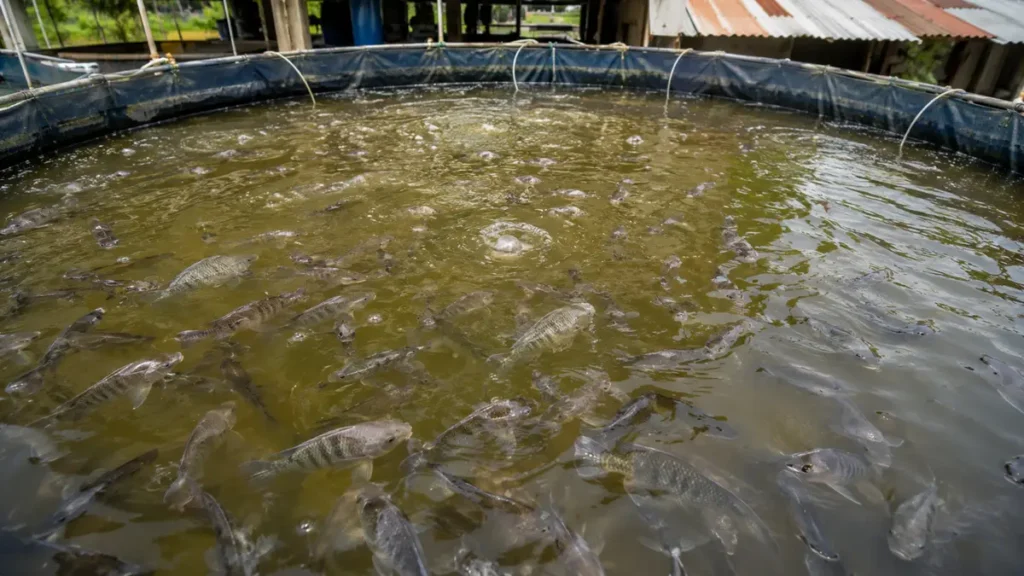
Not every fish tolerates the murky, bacteria-heavy water of a biofloc tank. Best fish for biofloc farming comes down to which species can physically handle lower dissolved oxygen and higher organic load.
- Tilapia — the default choice; hardy, fast-growing, forgiving of water swings
- Catfish — thrives in low-oxygen water, high feed conversion
- Barramundi — good growth rate, needs stable temperature
- Trout — profitable but requires temperature control, raising your equipment cost
- Bluegill / sunfish — solid beginner option in temperate US states
- Salmon — advanced setups only; not beginner-friendly
- Freshwater prawns (Macrobrachium) — technically a crustacean, but a strong biofloc performer
For a first attempt, tilapia and catfish are the two species that let your budget forgive small mistakes. Everything else on this list punishes error more expensively.
How Many Fish Fit in One Tank?
In a 10,000-liter tank:
- 1,000–2,000 tilapia
- 600–1,200 catfish
- 500–1,000 barramundi
Stocking density depends on your aeration capacity more than tank size — this is the part beginners get backwards.
Is Biofloc Farming Profitable? The Honest Math
Is biofloc farming profitable? Yes — when the aeration and feeding discipline holds up. Here’s a real-world example scenario:
- Investment: $2,000
- Production per cycle: 300–600 lbs
- Selling price: $4–$7 per lb
- Revenue: $1,200–$4,200 per cycle
- Profit: $800–$2,200 per cycle
- 3–4 cycles per year possible
That works out to an average ROI in the 100–220% per year range for well-managed small setups. But that number assumes zero major aeration failures and consistent feed discipline — which brings me to the part every competitor guide skips.
The Mistake That Costs Beginners the Most
Every biofloc guide I’ve read covers tank size and stocking density. Almost none of them explain why aeration failure is catastrophic rather than just inconvenient — and that gap costs beginners real money.
Here’s the biology: as biofloc matures, oxygen demand in the tank rises roughly sixfold compared to a freshly stocked tank. That’s not a typo. The bacteria colony consuming your fish waste is also respiring, competing with your fish for dissolved oxygen. A pump failure that a traditional pond would shrug off for hours can crash a mature biofloc tank in under 30 minutes, because there’s no large volume of water to buffer the oxygen drop.
[ANIL: if you’ve corresponded with any biofloc farmers, had a reader describe an aeration failure, or want to add your own observation on gill physiology and oxygen stress here, this is the spot — real detail from you goes here instead of this placeholder before publishing.]
The fix isn’t complicated, but it is non-negotiable: budget for a backup blower or a small generator from day one, even at small scale. It’s the $150–$300 line item every cost table lists as “optional” that actually isn’t.
USA Buyer’s Note: Suppliers, Training & Regional Cost Swings
Most biofloc cost guides are written for the Indian market, where a lot of the global training content originates. If you’re setting up in the USA, a few things shift:
Suppliers to check:
- Pentair Aquatic Eco-Systems — aeration, pumps, test kits
- AquacultureStore.com — probiotics, fingerlings, feed
- Amazon USA — air pumps, diffusers, heaters, testing kits (fastest for small-scale starts)
- Local aquaculture hatcheries — for regionally appropriate fingerlings (tilapia, catfish, trout)
Training options:
- University Aquaculture Centers (University of Arizona, Auburn University, Kentucky State University)
- USDA Aquaculture Extension and NOAA Sea Grant — often free or low-cost regional programs
- Online modules through Udemy or Coursera for a self-paced overview
Regional cost note: if you’re farming in a colder US state (Midwest, Northeast, Pacific Northwest), factor in heating cost as a real seasonal line item — not the token $20–$70 heater cost listed above, but the electricity to run it through winter months. This is the number most cost calculators quietly leave out, and it can shift your break-even point by a full season.
What the Science Says vs What Hobby Farmers Believe
Myth: “Biofloc water looks dirty, so it must be unhealthy for fish.”
Reality: According to research on biofloc technology compiled by aquaculture scientist Yoram Avnimelech, the brown, cloudy appearance of mature biofloc water is dominated by beneficial heterotrophic bacteria actively processing nitrogenous waste — the opposite of the “dirty water” hobbyists assume it to be. Clear water in a heavily stocked tank is actually the warning sign, not the murky water.
Myth: “More probiotics always means better biofloc.”
Reality: Research on biofloc systems published in the journal Aquaculture describes floc development as primarily driven by the carbon-to-nitrogen ratio you feed the system — not by how many bottled probiotics you dose. Dumping in extra carbon sources like molasses without tracking your feed’s C:N ratio (aim for roughly 15:1 to 20:1) does more for floc growth than any additive.
What this means for your budget: you can spend less on commercial probiotic products and more attention on a cheap carbon source — molasses, tapioca flour, or rice bran — and a $15–$40 ammonia test kit. That’s a smarter allocation of the same dollars.
Step-by-Step: Your First 24 Hours After Stocking
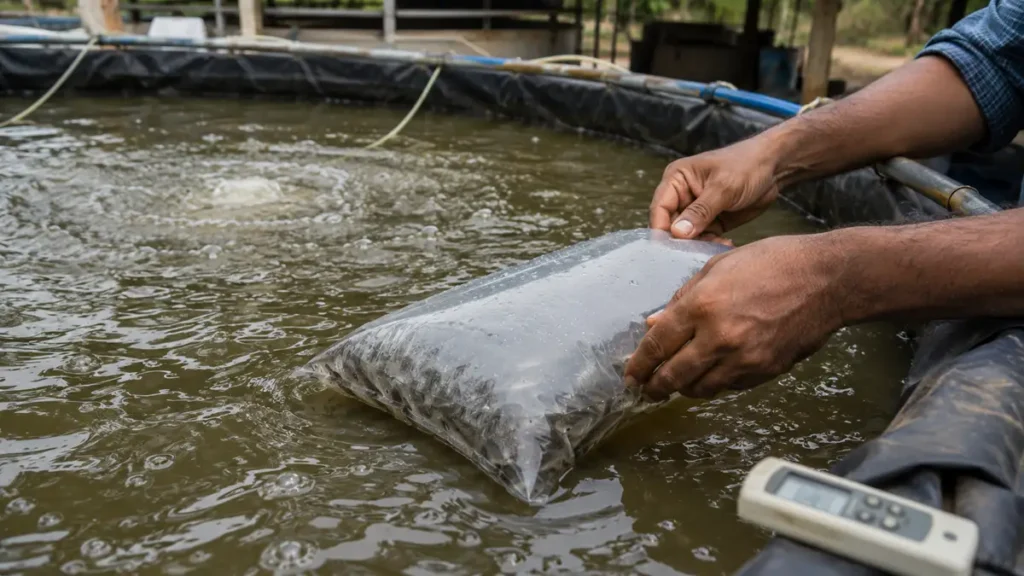
- Disinfect fingerlings with a brief potassium permanganate dip before release
- Float sealed bags in the tank for 15–20 minutes to equalize temperature
- Release fish gradually, monitoring for stress signs (gasping at the surface, erratic swimming)
- Run aeration continuously — do not switch it off overnight, even briefly
- Test ammonia and pH before feeding the next morning
- Feed a light first meal — overfeeding on day one is a common early mistake
- Log everything: water temp, DO, ammonia. This baseline matters more than people think
FAQs on How Much Does It Cost to Start Biofloc Farming
How much does it cost to start biofloc farming on a small scale?
A small 1–2 tank setup costs between $1,200 and $3,000, covering tanks, aeration, probiotics, fingerlings, and two months of feed. Costs scale up quickly once you add standby power or heating for cold climates.
How often should I test water parameters in a biofloc tank?
Test ammonia and dissolved oxygen daily during the first month, then at minimum every two to three days once the floc culture stabilizes. Skipping tests is the single most common way beginners miss an early ammonia spike.
Is biofloc farming safe if I’ve never kept fish before?
It’s beginner-friendly but not beginner-proof. You need basic comfort with water testing and consistent daily monitoring — the biology punishes neglect faster than a traditional pond would.
What’s the biggest beginner mistake in biofloc farming?
Underbudgeting for backup aeration. A single pump failure in a mature biofloc tank can crash oxygen levels within 30 minutes because the bacteria colony consumes oxygen alongside the fish.
Where can US beginners find biofloc equipment and training?
Pentair Aquatic Eco-Systems and Amazon USA cover most equipment needs, while USDA Aquaculture Extension and NOAA Sea Grant offer regional training, often at low or no cost.
Is biofloc farming profitable for a small operation?
Yes — small setups can see 100–220% annual ROI when aeration and feeding stay consistent. Profitability drops sharply if aeration failures cause repeated stock losses.
Do biofloc tanks smell or attract pests?
A properly maintained biofloc tank has no significant odor. Smell usually signals an ammonia spike or overfeeding, both correctable with a water test and a feeding adjustment.
Can I run biofloc farming indoors in a US garage or basement?
Yes, though indoor setups lose natural algae growth from sunlight and rely more heavily on bacterial floc alone. Ventilation and consistent temperature control matter more indoors than outdoors.
Bottom Line
How much does it cost to start biofloc farming? Realistically: $1,200–$3,000 to test it small, up to $50,000+ to run it commercially. But the number that actually determines whether you succeed isn’t in any of these tables — it’s whether your aeration budget accounts for failure, not just normal operation. Spend on backup power before you spend on a bigger tank. The fish can’t tell you when the oxygen is running low. The equipment budget is the only warning system you get.
Scientific References
- Avnimelech, Y. (2009). Biofloc Technology: A Practical Guide Book. World Aquaculture Society.
- De Schryver, P., Crab, R., Defoirdt, T., Boon, N., & Verstraete, W. (2008). The basics of bio-flocs technology: The added value for aquaculture. Aquaculture, 277(3–4), 125–137.
- NOAA Sea Grant Aquaculture Extension Program — regional biofloc and aquaculture training resources.
- USDA National Institute of Food and Agriculture — Aquaculture Extension Program.
Read More from FishioHub:
- Why Is My Fish Breathing Fast? — the oxygen-stress physiology behind the aeration-failure section above
- How to Remove Ammonia From a Fish Tank Naturally — for readers managing ammonia spikes in any tank system
- Can a Fish Tank Run Without a Filter? — relevant background on biological filtration principles that underpin biofloc
Was this guide helpful?
First-Hand Experience
Based on animals I've personally kept and bred - not summarized from other articles.
Zoological Foundation
Claims are checked against my M.Sc. Zoology training and published aquatic biology research, not recycled aquarium myths.
No Paid Influence
No sponsorship shaped this guide. Affiliate links, if any, are disclosed separately and never hidden.
Kept Current
Errors are corrected as soon as they're found, with the update noted at the bottom of the article.
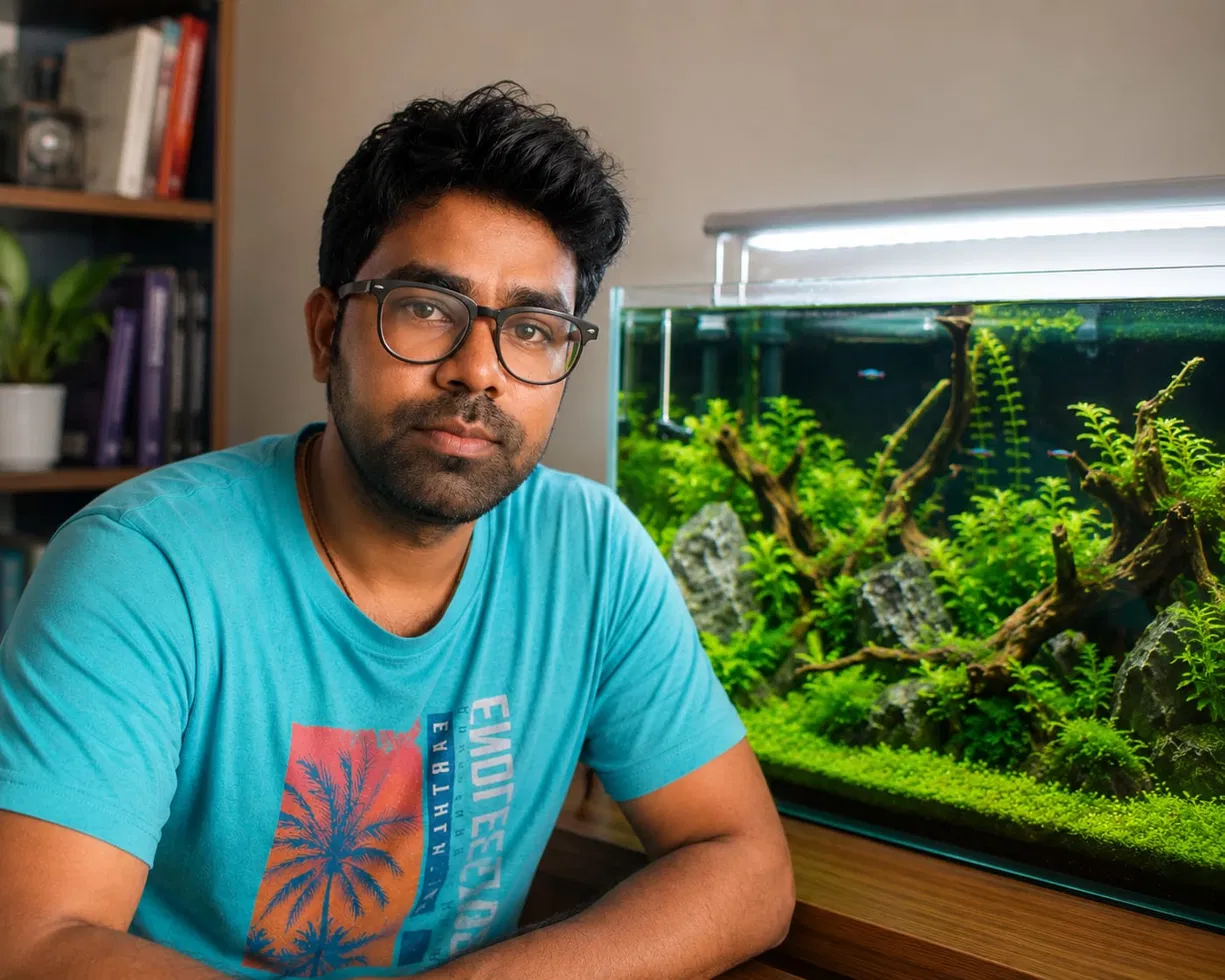
Anil Satak M.Sc. Zoology · Founder, FishioHub
Grew up in a fishing family in India and holds a Master's in Zoology. FishioHub is a one-person operation - every guide is personally researched, kept-tested, and written by Anil. No team, no outsourced writers, no AI-generated content. Read his full bio →