
Fish are often seen as simple, emotionless pets, busy with their activities. However, many aquarium owners claim that their fish recognize them, respond to them, and even show affection. This raises an intriguing question:
👉 Can fish form bonds with humans?
In this in-depth guide, we try to explore fish emotions, bonding behavior, scientific evidence, and real aquarium experiences to uncover whether fish can truly bond with their owners.
Can Fish Form Bonds With Humans? (Short Answer)
Yes — fish can form bonds with humans, but not in the same way mammals do.
Fish have the ability to recognize, exhibiting emotional responses, learning, and forming memories, which allows them to develop familiarity-based bonds with their owners over time.
These bonds are formed with the owner when:
- Food association
- Visual recognition
- Routine interaction
- Stress reduction around familiar humans
Can Fish Recognize and Bond With Their Owners?
Research and aquarium observations confirm that many fish can recognize individual humans specially their owners.
How Fish Recognize Humans
- Facial recognition (documented in archerfish)
- Movement and posture of a person
- Voice vibrations
- Feeding patterns and timing
Fish that see the same person daily often:
- Swim toward them
- Follow their finger in the tank
- Become excited during feeding time
- Show calmer behavior in their presence
👉 This behavior strongly shows the fish bonding with humans.
Can Fish Show Affection to Humans?
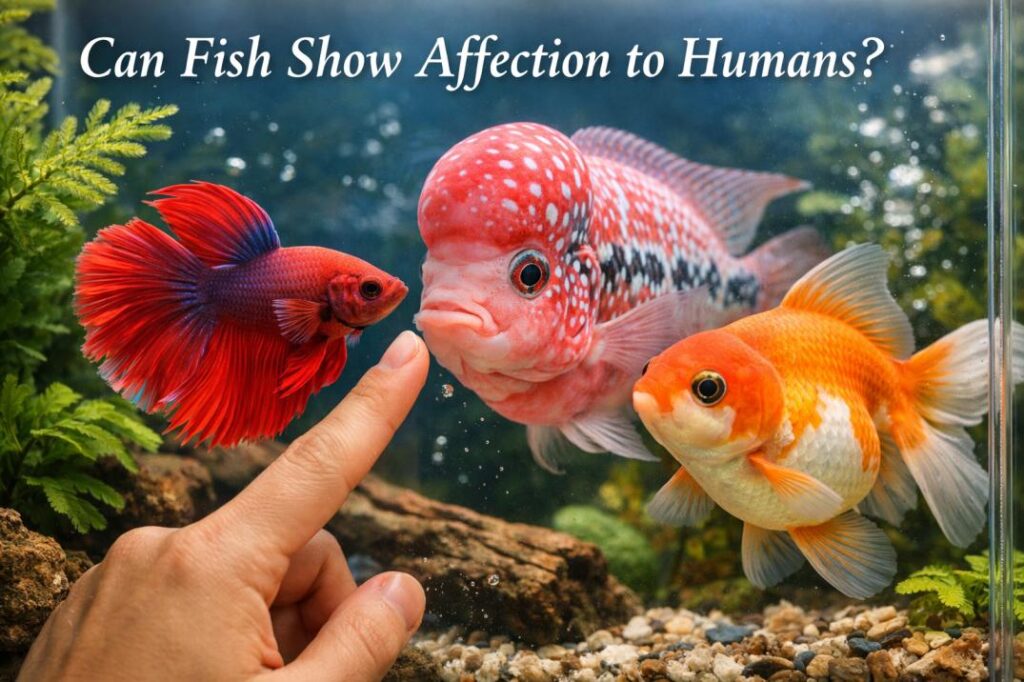
Fish don’t hold someone in their arms, but they show affection in fish-specific ways.
Signs of fish bonding show:
- Swimming to the glass when you approach the tank
- Gentle nudging during feeding
- Following your hand or finger when you move
- Displaying relaxed fins and calm movement
- Reduced hiding behavior when you approach
These behaviors indicate trust and positive emotional association, which is the foundation of bonding.
Can Fish Feel Emotion? What Science Says
Modern science has proved that fish can feel emotions.
Scientifically Proven Fish Emotions
Fish can experience and show emotions and feelings like humans:
- Fear
- Stress
- Pleasure
- Anticipation
- Relief
Scientific studies show fish produce neurochemicals like dopamine and serotonin, similar to humans, which are linked to emotions and reward systems.
👉 So yes, fish can feel emotion, though it is simpler than human emotions.
Can Fish Feel Love? (Important Clarification)
Fish do not feel romantic or emotional love as humans do.
However, fish can show attachment or bonding towards someone:
- Comfort
- Familiarity
- Preference
- Safety around specific humans
This is best described as attachment, not love — but attachment is still a meaningful emotional bond.
Do Fish Have Feelings for Their Owners?
Fish can develop positive emotional bonding associations with their owners.
If a fish:
- Recognizes you whenever you are around
- Reacts differently to you vs strangers near the tank
- Appears calmer when you are present near
Then it means that, yes, fish do have feelings for their owners, rooted in familiarity, natural bonding and trust.
Fish Bonding Explained: How It Actually Works
Can fish bond with humans: Fish bonding is a natural behavioral and associative, not emotional dependency.
Key Factors That Build Fish Bonding
- When a person feeds them regularly
- Gentle tank interaction (no sudden movements)
- Clean, stress-free aquarium environment
- Visual interaction (fish can learn faces and shapes)
- Time and routine
Fish that feel safe and rewarded associate humans with positive experiences.
Are There Pet Fish Known for Forming Strong Bonds With Humans?
Yes — There are some species of fish far more interactive and intelligent than others.
Pet Fish That Bond Strongly With Humans
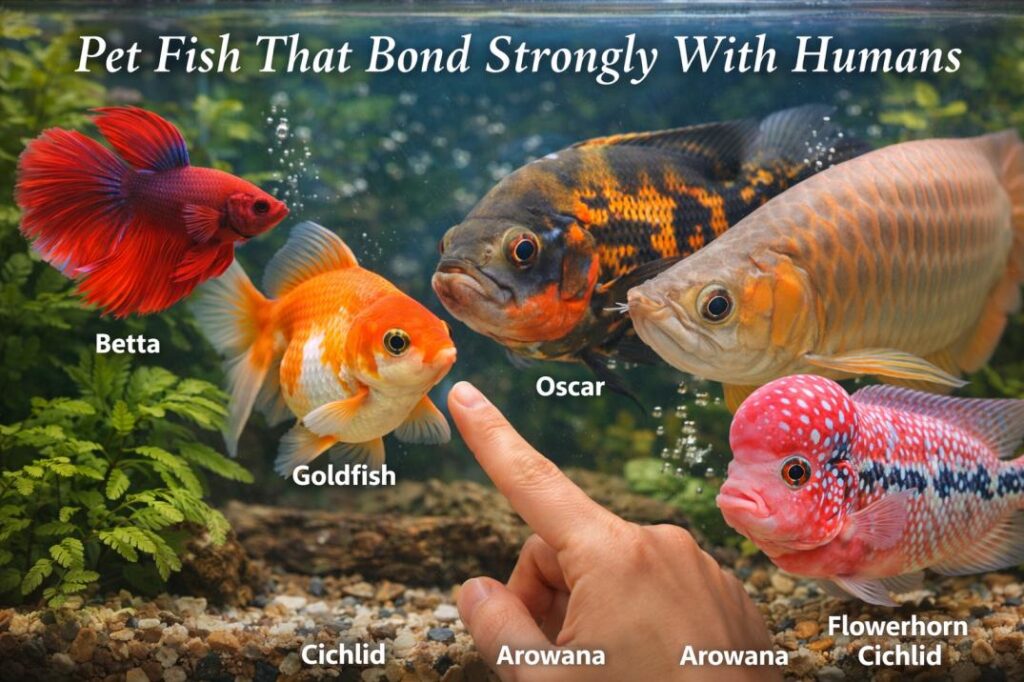
- Betta Fish – Highly interactive and recognize owners
- Goldfish – has Excellent memory, face recognition
- Oscars – Dog-like behavior, follow owners around, move
- Cichlids – Strong personality and recognition
- Arowana – High intelligence and awareness
- Flowerhorn Cichlids – Extremely owner-focused species
These fish often display clear bonding behavior.
How Much DNA Do Humans Share With Fish?
Humans share approximately 60–70% of their genes with fish, depending on the species.
This doesn’t mean fish think exactly like humans, but it explains:
- Shared neurological pathways
- Similar stress and reward hormones
- Comparable learning mechanisms
👉 This genetic overlap helps explain why fish can experience emotions and learning.
Common Myths About Fish Emotions (Debunked)
The following are some myths about fish, but humans should understand that fish is a living creatures; they has feeling, emotions, bonding, reacts to the pain.
❌ Fish have a 3-second memory
✔ No, Fish can remember for months or years
❌ Fish don’t feel pain or emotion
✔ No, Fish respond neurologically to pain and stress
❌ Fish are decorations, not pets
✔ Fish exhibit learning, recognition, and bonding
How to Strengthen Your Bond With Your Fish
You can create a very strong bond or affection with your fish; if you do these things regularly:
✅ Feed them on a schedule
✅ Use slow, calm movements
✅ Talk softly near the tank
✅ Avoid tapping on glass
✅ Keep water quality excellent
✅ Spend time observing daily
Bonding may take weeks to months, but it works.
Conclusion: Can fish form bonds with humans?
✔ Fish can form bonds with humans
✔ Fish recognize and remember their owner’s face
✔ Fish feel emotions and attachment, not love
✔ Some species bond more strongly than others
Fish bonding is real, scientific, and observable — just expressed differently than in mammals.
When treated with care and consistency, fish can form trust-based emotional connections with their human caregivers.
Read More from FishioHub:
FAQs on Can fish form bonds with humans?
Can fish recognize their owners?
Yes. Many fish can recognize individuals by humans by sight, movement, and routine.
Do fish feel love toward humans?
Fish do not feel love like humans, but they feel bonding and familiarity.
Which fish bond the most with humans?
Some fish species, like Bettas, goldfish, Oscars, and cichlids, are known for strong bonding behavior.
Can fish miss their owners?
Yes, Fish may show stress or altered behavior if their routine changes or a familiar caretaker is absent.
Are fish emotionally intelligent?
Yes, Fish exhibit emotional responses, learning ability, and memory, albeit simpler than those of mammals.