
I want to start with complete honesty: Cardinal tetra breeding is one of the most challenging freshwater breeding projects a home aquarist can attempt. I don’t want to discourage you, but understanding exactly why it is difficult is the first step toward actually succeeding.
During my zoology studies, I researched Paracheirodon axelrodi and its Rio Negro blackwater habitat. What surprised me most was this: a fish that thrives easily in community tanks becomes extremely difficult to breed once you try to spawn it intentionally.
But here is what I also know: it has been done successfully by dedicated home aquarists. With the right setup, the right water, and realistic expectations, cardinal tetra breeding is achievable. This post tells you everything you need to know.
Quick Answer: Cardinal tetras can be bred in captivity, but only under very specific conditions: ultra-soft, acidic water (pH of 4.5 to 6.0), near-total darkness, and a dedicated breeding tank. Most attempts fail because of poor water chemistry, too much light, or improper fry care. With the right setup, a spawn can produce 100–200 fry.
If You Are in a Hurry — Quick Overview of Cardinal Tetra Breeding
- Breeding Difficulty level: Advanced — not recommended for beginners
- Separate breeding tank needed: Yes — mandatory
- Water pH required: 4.5 to 6.0 — very soft, very acidic
- Darkness required: Near-total — eggs and fry are light-sensitive
- Typical fry per spawn: 100 to 500 eggs, 100 to 200 fry surviving to adulthood
- Time to first color in fry: 4 to 5 weeks
- Breeding temperature: 77 to 82°F (25 to 28°C)
What You’ll Get in This Post
- Is my cardinal tetra pregnant? What you actually see
- Cardinal tetra breeding behavior — signs spawning is near
- How to sex cardinal tetras
- The dedicated breeding tank setup
- Cardinal tetra Breeding water — the most critical factor
- The spawning process step by step
- Cardinal tetra eggs — what to look for
- Why most home breeding attempts fail
- Full Cardinal Tetra Breeding Parameters
- FAQs
Can Cardinal Tetras Breed in an Aquarium?
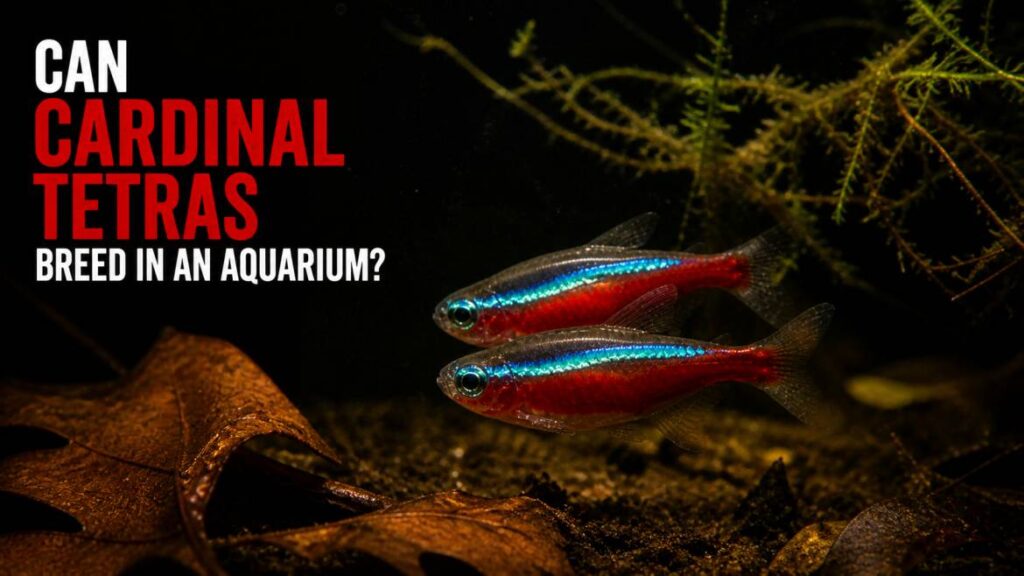
Yes, breeding of cardinal tetra in aquarium conditions is possible, but it’s more difficult than breeding many other tetra species. Initially, we should consider tetra. In the wild, cardinal tetras spawn in soft, acidic blackwater streams across South America, especially in the Rio Negro basin. Now, to replicate those breeding conditions in a USA home aquarium, it is a tough task; you’ll usually need:
- Very soft water
- Water pH level below 6.5
- Dim lighting near dark
- Warm stable temperature
- Separate breeding tank
Most successful breeders in the USA use a dedicated spawning tank rather than relying on a regular community tank for breeding.
Why Cardinal Tetra Breeding Is Harder Than Neon Tetras
If you are thinking like most of the hobbyists, breeding cardinal tetras is the same as breeding neon tetras. Then you are totally wrong. That’s entirely a different game.
| Feature | Cardinal Tetra | Neon Tetra |
|---|---|---|
| Breeding Difficulty | Hard | Moderate |
| Water Sensitivity | Very High | Medium |
| Preferred pH | 4.5–6.0 | 5.5–6.8 |
| Egg Light Sensitivity | Extremely High | High |
| Fry Survival Rate | Lower | Higher |
One thing I learned personally is that cardinal tetra eggs are incredibly sensitive to bright light. My first spawn failed because I left the aquarium light on overnight. By morning, almost every egg had turned white from fungus.
Signs Your Cardinal Tetras Are Ready to Breed

I have seen so many aquarists searching for “cardinal tetra pregnant,” but biologically, cardinal tetras do not become pregnant because they are egg scatterers. Instead, females become noticeably fuller with eggs.
Female Cardinal Tetra Breeding Signs
- You will see a rounder belly of the female cardinal tetra
- The body shape will be slightly larger
- Less streamlined appearance
- Increased interest from males
Male Cardinal Tetra Breeding Signs
- Becomes more active in swimming
- Chasing females often
- Intensified blue and red coloration on the body
- Territorial behavior near plants
In my experience, feeding live foods for about 2 weeks makes the biggest difference before spawning. Good conditioning foods include: You can feed baby brine shrimp, daphnia, bloodworms, and high-quality micro pellets.
Cardinal Tetra Breeding Behavior- Signs Spawning Is Near
Understanding the breeding behavior of Cardinal Tetras is the key to successfully breeding them. Typically, this process begins early in the morning, before daylight has fully broken. The male fish chase the females amidst the plants or moss, often darting rapidly back and forth.
During spawning:
- During the breeding season, male Cardinal Tetras become more active and gently pursue the females.
- You will also observe that Cardinal Tetras swim alongside one another, swimming in perfect parallel is the clearest indication that spawning time is approaching.
- Before breeding, their blue and red colors often become much brighter; this intensification of color serves as a distinct signal.
- During the breeding, Cardinal Tetras usually hide in shady corners and dense vegetation, as they prefer dark environments to actively lay eggs.
- You will also notice both fish turning slightly to one side for a few moments while the female scatters eggs and the male fertilizes them immediately. This entire process can happen surprisingly fast.
- A healthy female may release around 100–500 eggs under ideal conditions, although adults may eat the eggs afterward if they are not removed.
- According to ornamental fish breeding studies from South American aquarium research publications, tetra egg survival drops sharply in hard alkaline water because fertilization rates decrease significantly.
How to Sex Cardinal Tetras
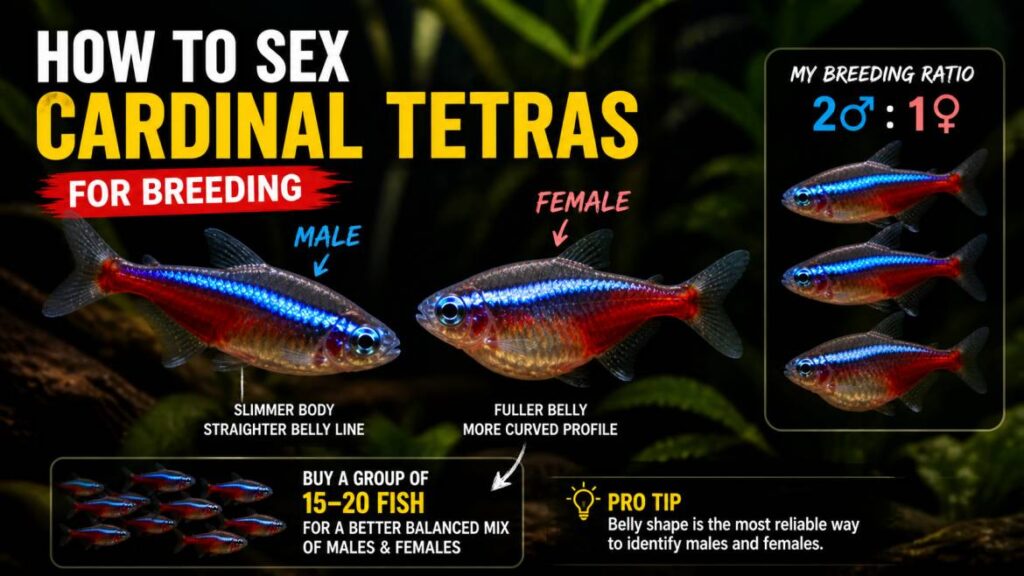
Accurately identifying the sex of your fish is crucial for establishing a successful breeding group. Without this ability, your entire strategy will fall apart. Cardinal Tetras exhibit subtle yet distinct differences based on sex, and you must be able to recognize them.
Males are slimmer with a straighter body profile and often show slightly brighter blue and red coloration when healthy. The size difference is subtle, so belly shape is the most reliable way to identify them.
One practical tip I always recommend: if you want to breed cardinal tetras, buy a group of 15–20 fish instead of just a pair. This gives you a much better chance of getting a balanced mix of males and females.
Best Cardinal Tetra Breeding Setup
If you truly wish to succeed in breeding Cardinal Tetras, never attempt to breed them haphazardly in a display tank; instead, set up a dedicated breeding setup specifically for them.
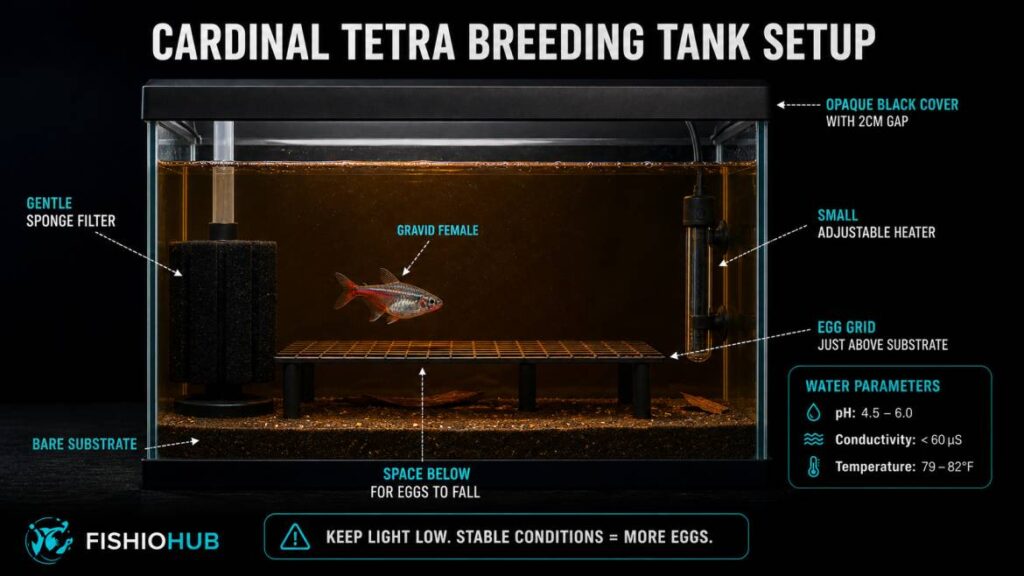
Recommended Cardinal Tetra Breeding Tank Setup
| Setup Element | Recommended |
|---|---|
| Tank Size | 10–20 gallons |
| Temperature | 79–84°F |
| pH | 4.5–6.0 |
| Hardness | Extremely soft |
| Lighting | Very dim |
| Filtration | Sponge filter |
| Plants | Java moss, spawning mops |
My Recommended Cardinal Tetra Breeding Setup
The setup that worked best for me was:
Tank Size and Equipment: A dedicated 10-gallon (A 10 to 20-gallon tank works well) blackwater tank with breeding group of 5 males and 5 females.
Equipment I recommend for US hobbyists:
- Sponge filter only for gentle flow protects eggs and fry, no substrate
- Adjustable heater, stable temperature matters a lot
- Indian almond leaves
- Java moss covering 40% of bottom
- Very low room lighting near to dark, The darker environment noticeably reduced stress.
The most important part? Darkness.
Cardinal tetra eggs are extremely light-sensitive. Even moderate light can destroy developing eggs. Keep the breeding tank heavily covered with only minimal airflow, closely mimicking the dark Rio Negro conditions where they naturally spawn.
Water Parameters Matter More Than Most Beginners Realize
Water parameters are of critical importance for Cardinal Tetra breeding, a point where many hobbyists in the USA often encounter difficulties.
The primary reason for this lies in the tap water supplied in many US states, which is so hard that it renders the breeding of Cardinal Tetras completely unsuccessful.
According to the USGS (United States Geological Survey), mineral levels in many municipal water systems across the United States range from moderate to hard, making the breeding of “blackwater” fish, such as the Cardinal Tetra, nearly impossible. So, let’s examine the ideal water parameters required for the Cardinal Tetra breeding.
Ideal Parameters:
pH: 4.5–6.0
GH: 1–2 dGH
KH: Close to zero
TDS: Less than 100 ppm
Many breeders utilize specific methods to achieve these conditions, such as using RO (Reverse Osmosis) water, distilled water, peat filtration, or Indian Almond leaves.
Can Cardinal Tetras Breed in a Community Tank?
Technically yes, but successful fry survival is very rare. Most community tank breeding attempts fail because eggs and fry get eaten by other animals, lighting is too bright, and water conditions are not ideal. I’ve occasionally seen spawning behavior in heavily planted tanks after water changes, but surviving fry are uncommon. If you want real breeding success, use a separate spawning tank.
How to Trigger Cardinal Tetra Spawning
Based on research and personal experience, the method I have shared with you here generally works well for most hobbyists.
Step-by-Step Process for Cardinal Tetras Breeding
- Condition the adult tetras: To do this, feed them a protein-rich diet for 10–14 days.
- Prepare the breeding tank: Keep the lighting in the tank very dim for tetra breeding.
- Introduce a pair or a group into the tank to facilitate breeding opportunities.
Personally, I prefer this configuration: 2 males and 1 female; this increases competition among them and enhances breeding-related activity. - Slightly raise the temperature: Gradually increase the water temperature to 82°F.
- Perform a partial water change: Replacing a small amount of water with cooler, softer water often simulates the environment of a rainforest.
Surprisingly, this method worked exceptionally well in my setup.
Cardinal Tetra Eggs: What to Expect
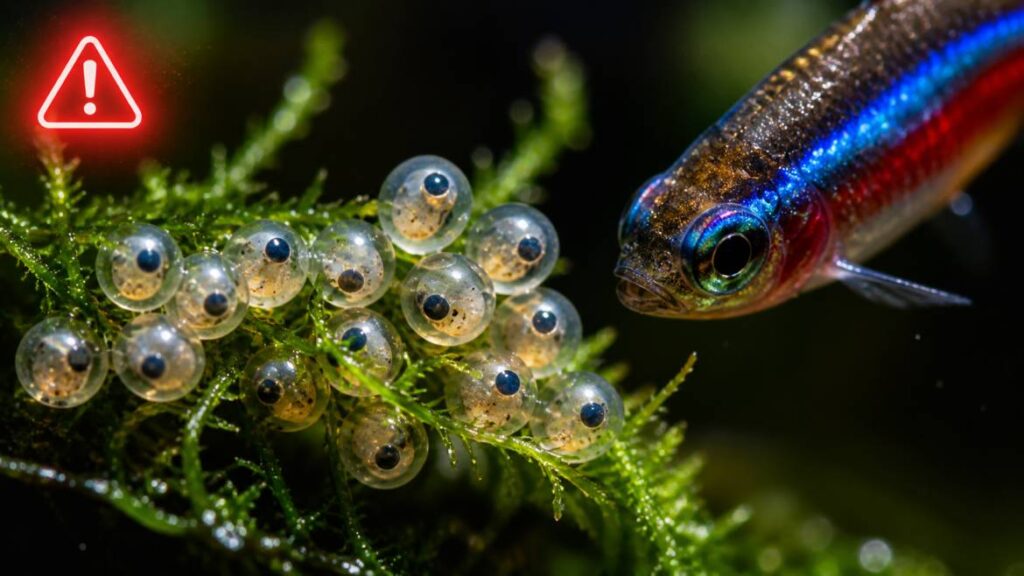
Cardinal Tetra eggs are very small, transparent, and extremely sensitive to light. Under the right conditions, they typically hatch within 24 to 36 hours.
People often make the mistake of exposing the tank to excessive light, which results in the death of the embryos. To avoid this, you should immediately remove the parent fish after spawning, keep the lighting in the tank very dim, and avoid any sudden movements. Fungal growth can also become a major issue. Some breeders use Methylene Blue, but I personally prefer using clean water combined with the natural tannins released by Indian Almond leaves.
How to Successfully Raise Cardinal Tetra Fry
To be honest, the fry stage is the most challenging. Newborn Cardinal Tetra fry are extremely tiny. For the first few days, they feed primarily on microscopic organisms.
The best initial food sources include:
- Infusoria
- Green Water
- Vinegar Eels
- Commercial Fry Powder
After approximately one week:
Baby brine shrimp become the ideal food source:
An aquatic nutrition study supported by NOAA found that when live food is introduced early on, the survival rate of larval fish improves significantly; this is because it increases protein availability and fosters a natural feeding response triggered by movement.
Lighting Tips: Keep the lighting subdued even after the eggs have hatched. Bright light causes stress to the fry and promotes the growth of algae.
Most Common Cardinal Tetra Breeding Mistakes

- Using Hard Water: This is the biggest mistake in cardinal tetra breeding.
- Too Much Light: Aquarist must know cardinal tetra’s eggs are highly sensative to light, they are transparent.
- Leaving Parents With Eggs: One thing should be kept in mind the adults often eat eggs quickly.
- Poor Fry Food: Most fry starve before reaching visible size.
- Unstable Parameters: Cardinal tetras dislike sudden changes this can led to the failure of cardinal tetra breeding.
Real Experience Insight Most Guides Miss
Here’s something most breeding guides never gonna tell you: cardinal tetra breed on their schedule, not yours. I can say this on behalf of my experience, I’ve had perfectly healthy groups ignore spawning for weeks, then suddenly breed right after a rainy-weather shift and a soft water change.
In my experience, subtle environmental triggers usually matter more than expensive equipment.
Scientific & Expert Facts About Cardinal Tetras
- Stable temperatures between 79°F–84°F improve tropical tetra egg development rates compared to cooler unstable environments.
- Cardinal tetras originate mainly from blackwater tributaries of the Amazon Basin where pH can naturally fall below 5.0.
- Research from tropical fish ecology studies shows blackwater fish species evolved under extremely low mineral conditions.
Most Neon Tetra Diets Miss What These Fish Actually Eat in the Wild
In the Amazon, neon tetras feed on a surprisingly diverse mix of zooplankton, insect larvae, micro-crustaceans, biofilm, and plant matter — not just basic flakes. Understanding their natural feeding behavior can completely change their coloration, activity levels, breeding condition, and long-term health in captivity.
This detailed guide breaks down exactly what neon tetras eat in the wild and how to realistically replicate that diet in a home aquarium.
👉 Read the full guide here: What Do Neon Tetras Eat in the Wild? Amazon Diet Revealed
Full Cardinal Tetra Breeding Parameters Table
| Parameter | Community tank | Cardinal Tetra Breeding tank requirement | Why it matters |
| pH | 6.0–7.0 | 4.5–6.0 | Triggers spawning instinct |
| Hardness | 2–8 dGH | 0–2 dGH | Replicates Rio Negro conditions |
| Conductivity | 50–200 μS | 20–60 μS | Critical spawning trigger |
| Temperature | 75–80°F | 79–82°F | Simulates wet season warming |
| Light level | Normal | Near-total darkness | Eggs are photosensitive |
| Tank size | 20+ gallons | 10–20 gallons | Separate dedicated setup |
| Filtration | Normal | Gentle sponge filter only | Prevent egg disturbance |
| First fry food | N/A | Paramecium / infusoria | Brine shrimp too large at day 4 |
| Parent removal | N/A | Immediately after eggs confirmed | Cardinals eat their own eggs |
| Time to visible color | N/A | 4–5 weeks | Blue stripe appears first |
FAQ: Cardinal Tetra Breeding
- How long does it take cardinal tetras to breed?
Conditioned adults may spawn within a few days to several weeks depending on water conditions and stress levels. - How can you tell if cardinal tetras are mating?
Males chase females aggressively through plants while displaying brighter colors. - Are cardinal tetra eggs visible?
Yes, but they are tiny transparent eggs usually attached loosely around plants or spawning mops. - Can cardinal tetras breed without a separate tank?
Possible, but fry survival is extremely low in community aquariums. - What is the ideal cardinal tetra breeding temperature?
Around 79°F–84°F works best for spawning and egg development. - How many eggs do cardinal tetras lay?
A healthy female may scatter 100–500 eggs during spawning. - Why are my cardinal tetra eggs turning white?
Usually fungus or unfertilized eggs caused by poor water conditions or bright lighting. - Are cardinal tetras hard to breed?
Yes — they are considered moderately difficult compared to many beginner aquarium fish.
You Are Breeding Cardinals — Now Learn How They Coexist With Shrimp
Cardinal tetra breeding produces significant numbers of fry that need appropriate tank mates as they grow. If you are also keeping a shrimp tank and wondering whether your cardinals and shrimp can share space safely, I covered the complete compatibility picture in the FishioHub cardinal cluster.
👉 Read next: Cardinal Tetra With Shrimp: Safe or Total Disaster? — FishioHub
Final Thoughts
Cardinal tetra breeding is one of those aquarium challenges that teaches you patience more than anything else. Once you finally see tiny fry swimming through dim blackwater conditions, it feels incredibly rewarding. The biggest lesson I learned is this: success usually comes from controlling the environment, not constantly changing equipment.
Focus on:
- Ultra-soft water
- Stable warmth
- Dim lighting
- Patience
And your chances of success in cardinal tetra breeding will improve dramatically.
If you enjoy tetra care and compatibility guides, you should also read my detailed comparison on
👉 Cardinal Tetra vs Neon Tetra, especially if you’re deciding which species is easier for breeding and beginner aquariums.
Was this guide helpful?
First-Hand Experience
Based on animals I've personally kept and bred - not summarized from other articles.
Zoological Foundation
Claims are checked against my M.Sc. Zoology training and published aquatic biology research, not recycled aquarium myths.
No Paid Influence
No sponsorship shaped this guide. Affiliate links, if any, are disclosed separately and never hidden.
Kept Current
Errors are corrected as soon as they're found, with the update noted at the bottom of the article.

Anil Satak M.Sc. Zoology · Founder, FishioHub
Grew up in a fishing family in India and holds a Master's in Zoology. FishioHub is a one-person operation - every guide is personally researched, kept-tested, and written by Anil. No team, no outsourced writers, no AI-generated content. Read his full bio →