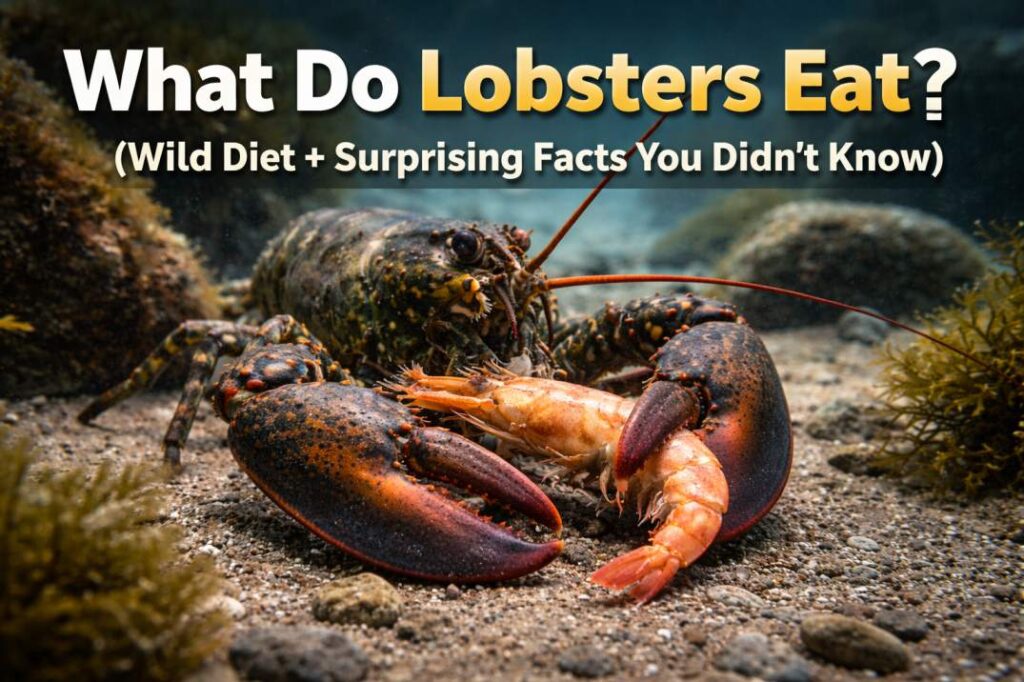
Growing up in a fishing family, I was surrounded by seafood from the time I could walk. Crabs, shrimp, fish of every kind. It has been a part of our daily life. But lobsters? Lobsters always fascinated me differently. They looked something like ancient armored creatures, and I was always curious: what do lobsters eat for food actually?
When I studied marine biology, I finally got the scientific answers to match what I had observed growing up near fishing communities. And honestly, what lobsters eat surprised even me.
Quick Answer: Lobsters are opportunistic omnivores. In the ocean, they eat fish, crabs, clams, mussels, sea urchins, marine worms, seaweed, and even dead animals. They are not selective, they eat whatever they get to eat on the ocean floor. Their exact diet varies by species, habitat, age, and season.
What You’ll Get in This Post
- What do lobsters eat in the ocean
- What lobsters eat in the wild vs captivity
- Do lobsters eat crabs, shrimp, and fish?
- Do lobsters eat seaweed?
- What different lobster species eat
- What is a lobster’s favorite food?
- Lobster diet comparison table
- FAQs about lobster diet
What Do Lobsters Eat in the Ocean?
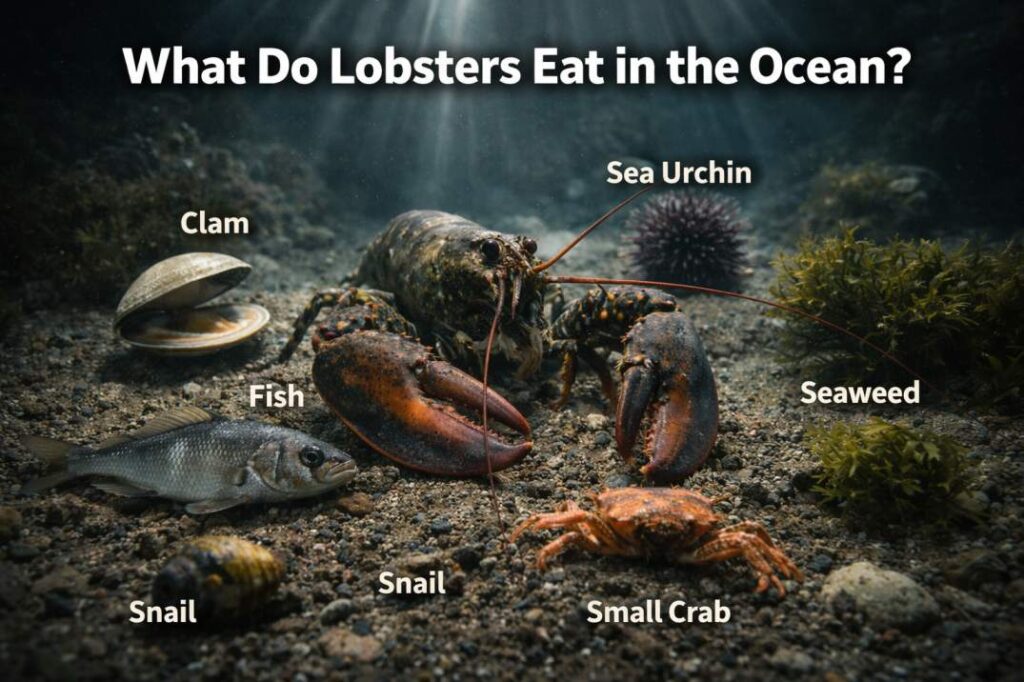
Whenever someone asks me about the diet of lobsters, I offer them a unique perspective: rather than viewing lobsters as predators, consider them the ocean’s most efficient “clean-up crew.”
Lobsters are creatures that inhabit the ocean floor. Consequently, they spend their entire lives crawling along the seabed, and their dietary habits are a direct reflection of this lifestyle. You will not see them chasing after fast-moving prey in open waters. Instead, they systematically consume whatever organic matter they encounter on the ocean floor, whether living or dead.
Based on my studies and research conducted on marine seafood ecology, the primary diet of wild marine lobsters typically consists of the following:
- Mollusks — clams, mussels, scallops, and snails are lobsters’ most common prey
- Echinoderms — sea urchins and sea stars, which are abundant on rocky ocean floors
- Marine worms — polychaete worms found in ocean sediment
- Small and injured fish — they cannot chase fast swimmers, but slow or dead fish are fair game
- Crustaceans — including smaller crabs, shrimp, and yes, even other lobsters
- Plant material — seaweed, kelp, and algae when animal prey is scarce
- Carrion — dead animals on the ocean floor are a significant food source
According to NOAA Fisheries, American lobsters (Homarus americanus) are considered highly opportunistic feeders whose diets change considerably with the season, water temperature, and prey availability. In colder winter months, their metabolism slows and feeding drops significantly, while summer and early fall represent peak feeding periods.
Studies examining lobster stomach contents and feeding behavior have shown that lobsters typically consume crustaceans such as shrimp and crabs, along with mollusks, small fish, and even plankton during their early life stages. What stands out is that their diet isn’t fixed; it largely depends on what is most readily available in their habitat.
What Lobsters Eat in the Wild vs in Captivity
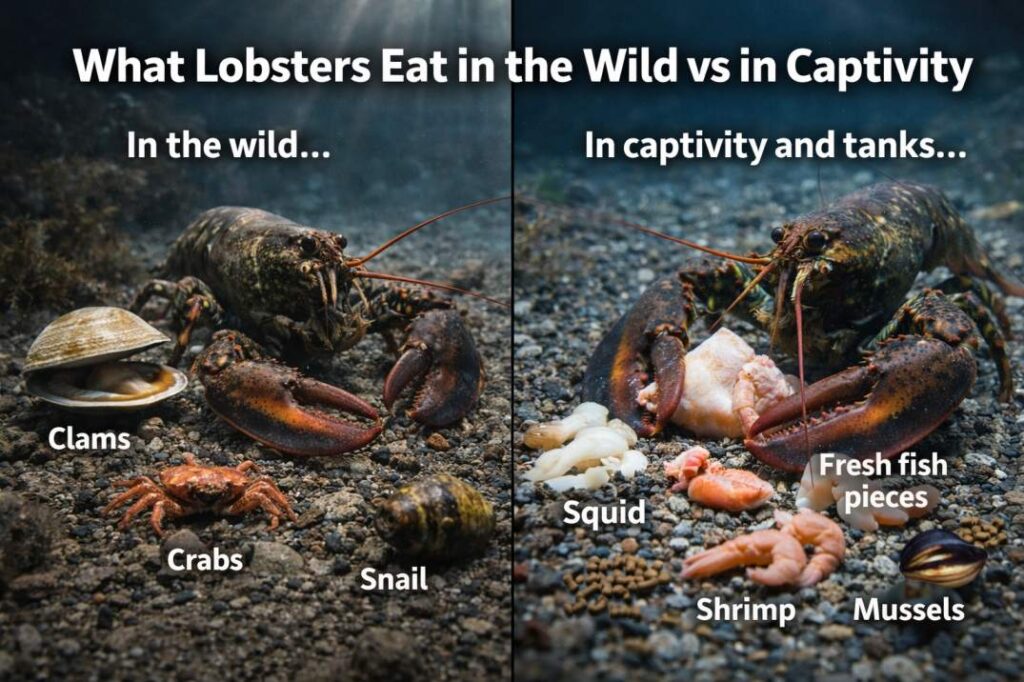
In the wild
To evade predators, wild lobsters remain hidden during the day within rock crevices or burrows. They become active at night, emerging from their hiding spots to roam the ocean floor in search of food.
Unlike crabs, a lobster’s two claws are distinct from one another, and each serves a specific function. There is a large and strong “crusher” claw, used to crack the hard shells of prey such as clams, crabs, and snails, and a sharper “cutter” claw, designed to tear through soft flesh. Together, these two claws enable them to capture a wide variety of prey.
Their foraging behavior can also vary depending on the season and the surrounding environment. In many regions, it has been observed that lobsters are more active and feed more vigorously during the warmer months.
In captivity and tanks
Lobsters kept in aquariums, restaurant tanks, or home setups eat a simplified version of their wild diet. In captivity, they are typically fed:
- Fresh fish pieces — herring, mackerel, or whatever is available
- Squid and octopus pieces
- Shrimp — which they eat eagerly
- Mussels and clams — still their preferred food
- Commercial crustacean pellets for convenience
One thing I find interesting from a behavioral biology perspective is that well-fed captive lobsters are noticeably less aggressive than underfed ones. Food security directly affects their behavior, which is an important consideration for anyone keeping lobsters in tanks.
Do Lobsters Eat Crabs, Shrimp, and Fish?
This is one of the most common questions I get about the lobster diet, and the answer is yes to all three. Let me break each one down.
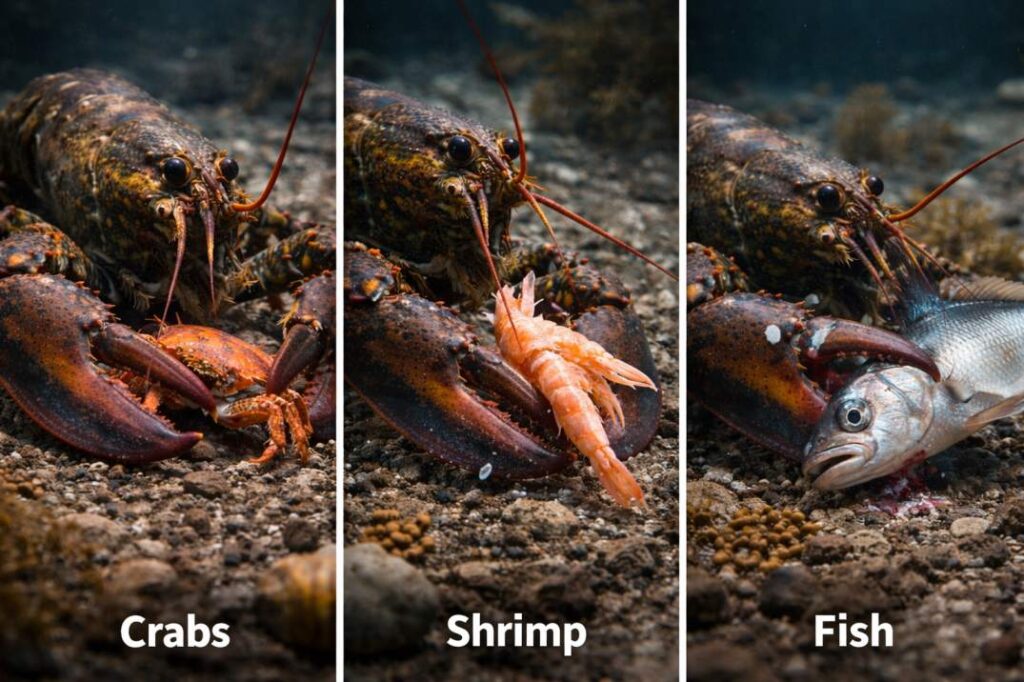
Do lobsters eat crabs?
Yes, lobsters eat crabs, and this actually surprised me when I first encountered it in my research. Lobsters will actively prey on smaller crabs when the opportunity arises. They use their crusher claw to break the crab’s shell and the cutter claw to access the meat inside. Here one thing i should say, the crabs are not easy prey for lobsters because they fight back. This is why lobsters generally prefer less resistant food sources. But smaller or recently molted crabs with soft shells? They are not safe from lobsters.
Do lobsters eat shrimp?
Yes, lobsters are actually one of the easiest prey for lobsters. Shrimp are smaller than fish and slower to escape, yet richer in nutrients. In both wild and captive environments, lobsters readily consume shrimp. Having grown up amidst fishing communities, I have frequently observed that shrimp remains are sometimes found inside lobster traps.
Do lobsters eat fish?
Lobsters cannot chase down fast-swimming fish. Since their physical structure is not designed for rapid swimming, they tend to remain in their immediate vicinity. However, slow-swimming fish, injured fish, and dead fish found on the ocean floor constitute a reliable and regular part of their daily diet. A 2019 study of stomach contents in the Gulf of Maine found fish remains in more than a third of all lobster samples examined. This confirms that fish constitute a consistent and significant component of the lobster’s diet in the ocean.
Do lobsters eat other lobsters?
It may sound strange, but lobsters do eat other lobsters. But this does not always happen; a larger lobster may eat a smaller lobster, especially when the smaller lobster is shedding its old shell and building a new one. At that stage, its new shell is still soft, leaving it completely vulnerable. From the perspective of the food chain, this behavior on the part of lobsters actually seems quite natural.
Do Lobsters Eat Seaweed and Plants?
Yes, lobsters do eat plants; however, plants do not constitute their primary diet. Lobsters consume seaweed, kelp, and algae when they encounter them while foraging, or when finding animal prey proves difficult. This effectively makes them omnivores, rather than strictly carnivores as many people assume.
In this case, young lobsters are particularly interesting. During the initial months of their development, young lobsters consume a significantly higher proportion of plant-based matter relative to their body size, compared to adults. This is because, at this stage, lobsters are not yet strong enough to hunt effectively or to utilize their claws with full proficiency.
What Do Different Lobster Species Eat?
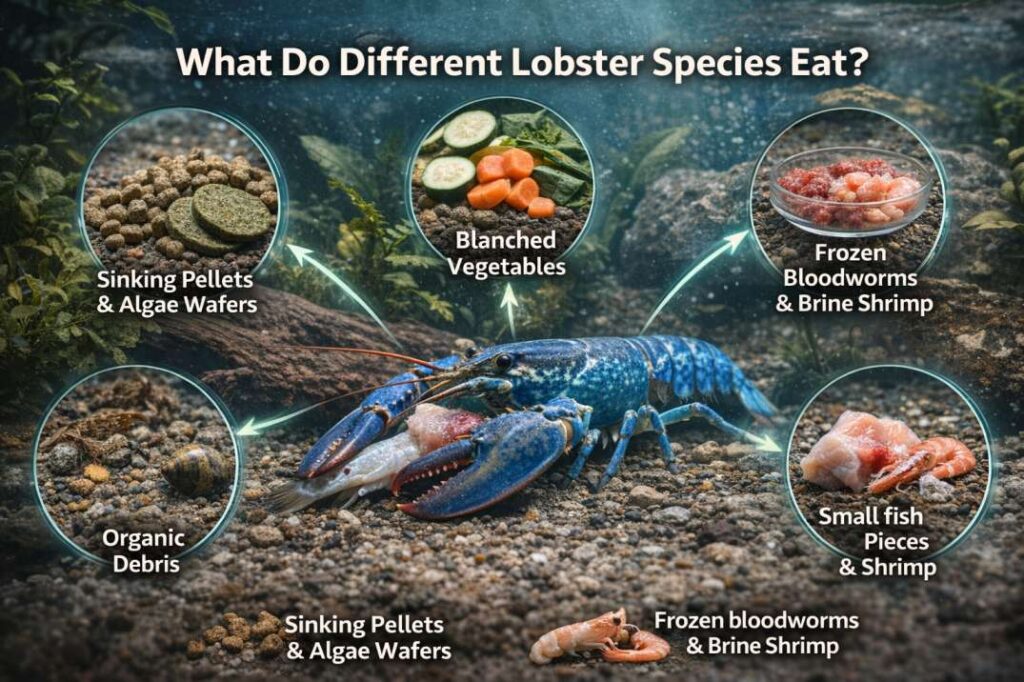
One of the things I love most about my work on FishioHub is getting to explore how different species within the same family live completely different lives. Lobsters are a perfect example; the word “lobster” covers many different species with meaningfully different diets. So let’s understand what do lobsters eat.
What do blue lobsters eat in a tank?
Blue lobsters, most commonly known as Procambarus alleni, a freshwater species popular in home aquariums, eat a very different diet from their ocean cousins. In a tank they thrive on:
- Sinking pellets and algae wafers as a staple
- Blanched vegetables like zucchini, spinach, and carrots
- Frozen bloodworms and brine shrimp as protein
- Occasional small pieces of fish or shrimp
- Any organic debris that settles on the tank bottom
Lobsters are highly enthusiastic cleaners in a tank and consume almost anything that settles at the bottom, including leftover fish food and decaying plant matter. This makes them very useful for cleaning the tank, but it also means that they need to be monitored. If they do not get proper food, they even eat live plants in the aquarium.
Remember one thing very clearly: marine lobsters and tank lobsters are two very different species.
What do river lobsters eat?
River lobsters, which are actually a species of freshwater crayfish, like the same food as blue lobsters. In their natural habitat, they consume algae, aquatic plants, insect larvae, small invertebrates, earthworms, and decaying organic matter. Within river systems, they actually play an important ecological role; They decompose dead organic matter and return nutrients to the ecosystem.
What do slipper lobsters eat?
Slipper lobsters (family Scyllarididae) are quite interesting from an anatomical point of view. They don’t have the large claws that most people associate with lobsters. Instead, their bodies are flat and distinctive, and their mouthparts are very strong; All of this makes them perfectly suited for a specific type of hunting. Slipper lobsters primarily eat bivalves, such as clams and oysters, which they open using their body thrusts and mouthparts. Their dietary habits are far more specialized than those of the American lobster.
What do Florida lobsters eat?
The Florida spiny lobster, found in the warm waters of the Florida Keys and the Caribbean, does not possess large claws like common marine lobsters. Instead, they rely on their spines and their speed for protection.
The primary diet of the Florida spiny lobster consists of:
- Clams and bivalves
- Snails and other mollusks
- Marine worms
- Sea urchins, which are found in abundance in their warm-water habitat
- Occasionally, plant-based matter
The absence of large claws means that the Florida spiny lobster cannot crack open hard-shelled prey in the same manner as the American lobster.
What do red lobsters eat?
I get this question often, and I want to clarify something: “Red Lobster” is not actually a separate species. American lobsters (Homarus americanus) are greenish-brown when alive. They turn the familiar bright red color only when cooked, due to a chemical reaction that releases a red pigment called astaxanthin from the shell proteins. So the diet of a “red lobster” is identical to the American lobster diet, like mollusks, shrimp, crabs, worms, and sea urchins, etc., as described throughout this post.
What Is a Lobster’s Favorite Food?
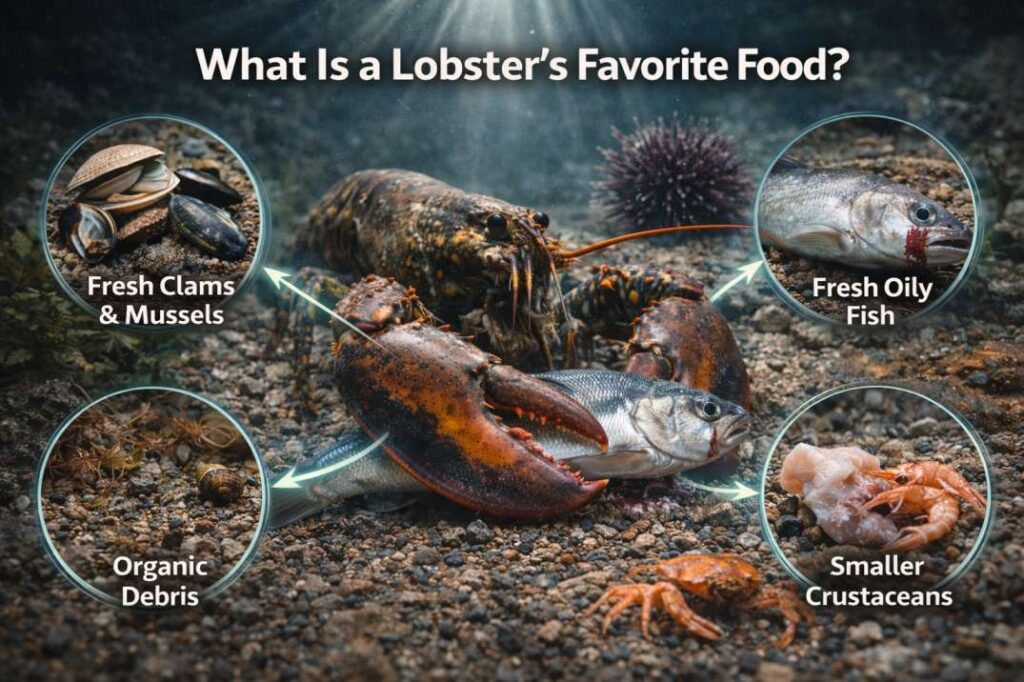
Based on both scientific feeding research and practical aquaculture experience, lobsters show the strongest and most consistent love towards these:
- Fresh clams and mussels — high protein, easy to access, their crusher claw is perfectly built for these
- Sea urchins — abundant on rocky ocean floors, nutritionally dense
- Fresh oily fish — particularly herring, which is used as the primary feed in commercial lobster farming
- Smaller crustaceans — shrimp and soft-shelled crabs, when available
A 2021 study by Dalhousie University found that lobsters fed a diet rich in fresh herring had a growth rate several times faster than those fed only commercial pellets. This proves that lobsters not only love fresh fish but also find it essential for their growth. This confirms the fact that fish are also found along with lobsters in the fishermen’s nets.
Lobster Diet Comparison Table ( What Do Lobsters Eat)
| Lobster type | Habitat | What Do Lobsters Eat (Primary diet) | Has large claws? |
| American lobster | North Atlantic Ocean | Fish, mollusks, crabs, sea urchins | Yes — crusher + cutter |
| Florida spiny lobster | Warm Atlantic / Caribbean | Snails, clams, sea urchins, worms | No |
| Slipper lobster | Tropical oceans worldwide | Bivalves, clams, oysters | No — flat body |
| Blue lobster (freshwater) | Rivers, ponds, aquarium tanks | Pellets, vegetables, worms, shrimp | Yes — smaller |
| River lobster/crayfish | Freshwater rivers and streams | Algae, worms, insects, plant matter | Yes — smaller |
FAQs About What Lobsters Eat
What do lobsters eat the most?
Mollusks, especially clams and mussels, are the most frequent food items found in studies of wild lobster stomachs. They are abundant on the ocean floor, easily accessible, and high in protein.
Do lobsters eat seaweed?
Yes, lobsters eat seaweed and algae as a supplementary food source. Juvenile lobsters eat proportionally more plant material than adults.
Do lobsters eat snails?
Yes, Lobsters eat snails. Snails are one of the lobster’s preferred prey items. Their powerful crusher claw is specifically designed to break snail shells efficiently.
Do lobsters eat each other?
Yes. Lobsters are cannibalistic, particularly toward recently molted individuals with temporarily soft shells.
What do lobsters eat in a tank?
In tanks, lobsters are typically fed fresh fish, shrimp, mussels, clams, squid, blanched vegetables, and commercial crustacean pellets.
Do lobsters eat fish?
Lobsters regularly eat slow-moving, injured, or dead fish. They cannot chase fast swimmers, but consistently scavenge fish carcasses, which has also been proved by research and studies.
What is a lobster’s favorite food?
Research and aquaculture feeding trials consistently show that lobsters most eagerly consume fresh clams, mussels, sea urchins, and oily fish like herring; these are lobsters’ favorite foods.
How often do lobsters eat in the wild?
Wild lobsters do not follow a fixed feeding schedule. They forage opportunistically at night, with peak feeding in summer and early autumn. Winter feeding slows significantly as water temperature drops and metabolism decreases.
What Hunts Lobsters in the Same Waters?
Now you know exactly what do lobsters eat. But here is the other side of the story that I find just as fascinating. While lobsters are busy hunting clams and crabs on the ocean floor, powerful predators are hunting them.
Discover which ocean animals prey on lobsters and how lobsters survive in the same dangerous waters:
👉 Read next: What Animals Eat Lobster? 5 Powerful Ocean Predators — FishioHub
Final Thoughts
Lobsters are truly remarkable creatures; in terms of their dietary habits, they are far more complex than their nickname “the cockroach of the sea“ might suggest. I can tell you that this very dietary flexibility is, in fact, one of the primary reasons behind their evolutionary success. They have survived for millions of years precisely because they consume almost everything available in the ocean.
Understanding what lobsters eat helps us comprehend the ecosystem of the ocean floor where they reside.
— Anil Satak
Master’s in Zoology | Founder, FishioHub