Many beginners ask whether a filter is truly necessary in an aquarium, especially in small fish tanks or heavily planted setups. It’s a common question for new aquarists trying to save cost or maintain a minimalist look. So, can a fish tank run without a filter? Here’s the expert answer based on aquarium science and real-life practice.
⚠️ Yes, a fish tank can run without a filter, but only under very strict conditions.
The tank must be heavily planted, lightly stocked, and maintained with frequent water changes to safely support fish. Without these factors, harmful wastes like ammonia and nitrite build up quickly, which can stress or kill fish in the tank.
For most aquarists, especially for beginners, running a tank without a filter is very risky and not recommended. Can a fish tank run without a filter? Before the answer it is very necessary to know why filter is so important. Here’s the expert truth aquarists should know.
Why Filters Are Important in Aquariums
Can a fish tank run without a filter, and what conditions are required to keep water safe for fish? A filter does more than just keep the water looking clean. It performs essential biological and mechanical functions that help maintain a healthy ecosystem.
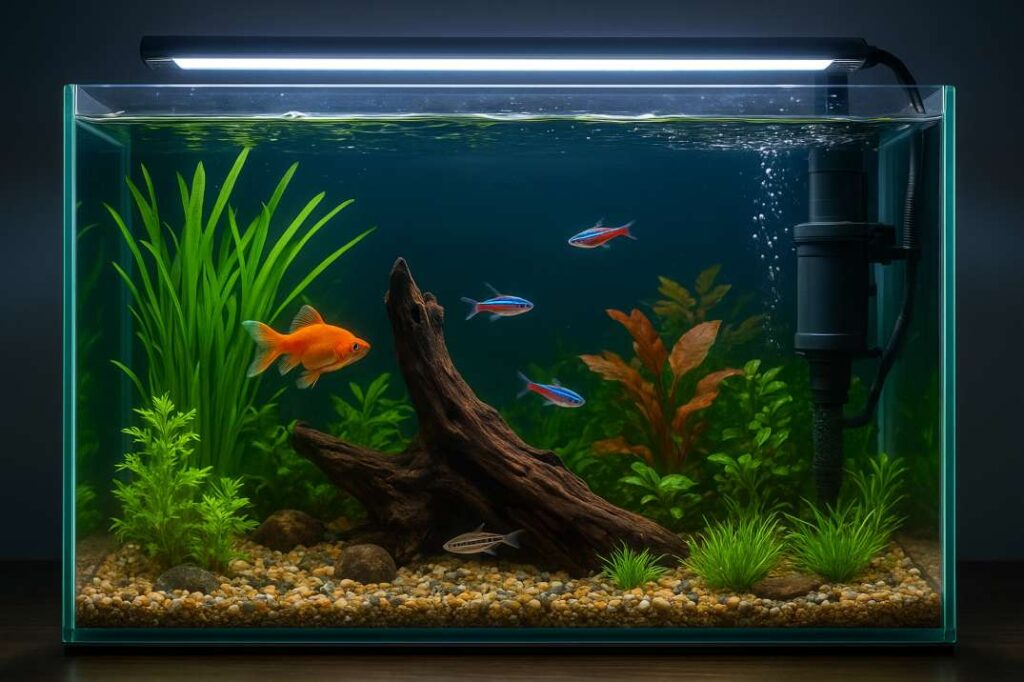
1. Filters support living beneficial bacteria
These bacteria break down ammonia (from fish waste, leftover food, and decaying plants) into nitrite, and then into the safer nitrate.
Without a filter surface for bacteria to live on, ammonia levels can spike dangerously fast.
2. Filters improve oxygen levels
When water movement created by filters, it increases oxygen exchange, which fish and bacteria need to survive.
A still aquarium can become low-oxygen, especially at night.
3. Filters trap physical debris
Food particles, fish waste, and plant fragments clog up the water if not removed.
Without filtration, the tank becomes cloudy, smelly, and unhealthy for fish and other creatures.
When Can a Fish Tank Run Without a Filter?
Filterless tanks are possible, but only when these specific conditions are met:
✔ Heavily planted aquarium
Fast-growing plants like hornwort, water sprite, Amazon swords, and floating plants naturally absorb ammonia and nitrate. So they can do the work of filter in some extent.
✔ Light fish population
Example safe stocking:
- 1 betta in 5–10 gallons
- 5–6 shrimp or snails in 3–5 gallons
✔ Frequent water changes
If water continusouly get changed at least 30–50% of the time, twice a week, to remove waste and refresh oxygen levels.
✔ Mature tank
A tank that has been cycled and stable for several months — not a new setup.
✔ Experienced keeper
Beginners often struggle to maintain balance without equipment.
Real Examples of Successful Filterless Aquariums
Can a Fish Tank Run Without a Filter? There are very few such examples.
Walstad Method Tanks
A natural method using soil substrate + dense live plants that balances nutrients without a filter.
However, it needs careful lighting, plant knowledge, and low stocking — not ideal for beginners.
Shrimp-only tanks
Shrimp produce low waste and thrive in planted nanos with regular maintenance.
Outdoor ponds
Nature balances itself through the sun, plants, and water circulation.
When a Tank Should Not Run Without a Filter
❌ New tanks that are not cycled for a time
❌ Tanks with goldfish (heavy waste producers)
❌ Community tanks with multiple fishes
❌ Tanks with messy eaters (cichlids, plecos, turtles)
❌ Tanks smaller than 3 gallons
Goldfish and many popular aquarium species need both biological and mechanical filtration to survive long-term.
Best Safe Alternative: Sponge Filter
For 99% of beginners, the simplest and safest solution is a sponge filter:
Benefits
- Cheap and easy to set up
- Silent
- Perfect for bettas, guppies, shrimp, fry, and community tanks
- Provides oxygen + biological filtration
- Doesn’t suck up small fish or shrimp
💡 Expert Tip: If you love the natural look, hide the sponge filter behind tall plants or hardscape.
Final Verdict
⭐ Yes, a fish tank can run without a filter, but it requires perfect balance, heavy planting, low stocking, and strict water maintenance.
For most aquarium hobbyists, especially newcomers, using a small sponge filter is the safest and most successful way to keep fish healthy.
A filter-free tank is possible — but not forgiving of mistakes.