The rarest fish on earth, the Devil’s Hole Pupfish (Cyprinodon diabolis). Found in only one place in the world—Devil’s Hole in Nevada, USA— Despite being less than an inch long, it has adapted to survive in one of the harshest environments. Such facts about this tiny fish have fascinated scientists and conservationists for decades.
In this post, we’ll explore everything you need to know about the very rare Devil’s Hole Pupfish—its location, diet, predators, population status, adaptations, reproduction, and much more.
🐟 What You’ll Get in This Post
In this detailed guide on the Devils Hole pupfish, you’ll discover:
- 📏 Devils Hole pupfish size – how small this rare fish.
- 📍 Devils Hole pupfish location – where this fish lives and why it exists nowhere else on Earth
- 📊 Devils Hole pupfish population – population and conservation efforts
- 🌊 Devils Hole pupfish habitat – Devils Hole and how the fish survives
- 🍽️ What do Devils Hole pupfish eat – Their natural diet and feeding behavior
- 💰 Devils Hole pupfish price – Can you buy one? Learn the legal and ethical truth about ownership
- ⏳ Devils Hole pupfish lifespan – How long this species lives in such harsh conditions
- ⚠️ Are Devils Hole pupfish dangerous? – A clear answer for curious readers (spoiler: they’re harmless)
Devils Hole Pupfish Location
The Devil’s Hole Pupfish lives exactly in Devil’s Hole, which is regarded for a deep water cave, in Death Valley National Park, Nevada (USA). The cavern is more than 500 feet deep and connected to a vast underground aquifer. It has a constant water temperature over 93°F and a low oxygen level.
The fish only occupy a shallow rock shelf near the surface, where sunlight supports algae growth. This extreme isolation is both a curse and a blessing—it protects them from predators but makes them highly vulnerable to environmental change.
Devils Hole Pupfish Size & Appearance
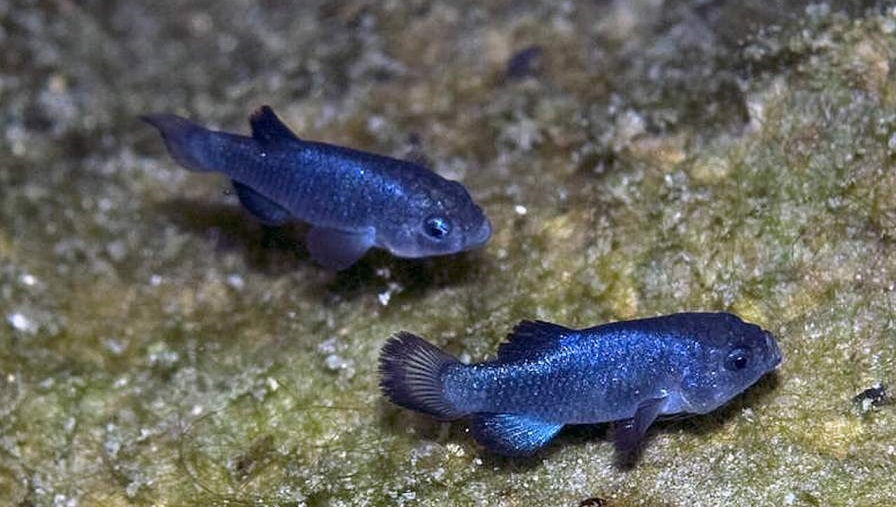
Image credit: Olin Feuerbacher / USFWS, Public Domain, via Wikimedia Commons.
The Devil’s Hole Pupfish is one of the smallest desert fish, measuring 0.7–1 inch (18–25 mm), about half an inch long.
- Males: Bright, shimmering blue during breeding season.
- Females: More silvery with a less vibrant look.
- Body Shape: Rounded fins and short bodies adapted to maneuver in shallow waters.
Devils Hole Pupfish Behavior
These fish show very unique behaviors:
- Territorial males aggressively defend spawning sites.
- They form small schools when not breeding.
- They are most active near the shallow sunlit shelf, where food and oxygen are available.
Devils Hole Pupfish Diet
Their diet is simple but specialized. The rarest fish survive on:
- Algae growing on the rocky shelf
- Aquatic invertebrates
- Organic detritus and microorganisms
Their ability to survive on limited food sources is a key adaptation to life in such a barren ecosystem.
Devils Hole Pupfish Predators
In their isolated cavern, the pupfish have no natural predators. However, if invasive species or birds were introduced, they could be a threat. In reality, the biggest dangers are:
- Habitat changes (water level fluctuations)
- Human disturbances
- Climate change
Devils Hole Pupfish Habitat & Adaptations
Surviving in near-boiling desert water requires unique adaptations:
- Can live in low oxygen levels (lower than most fish could survive).
- Can withstand high water temperatures (up to 92°F / 33°C).
- Small body size conserves energy.
- Flexible feeding habits.
Devils Hole Pupfish Reproduction
Breeding season occurs between April and October, when algae growth is strongest.
- Females lay a small number of eggs on the rock shelf.
- Eggs hatch within a few days.
- Reproduction is slow compared to other fish, which limits population growth.
Devils Hole Pupfish Lifespan
The pupfish live for about one year, which means each new generation is critical for survival. Their short lifespan makes them even more vulnerable.
Devils Hole Pupfish Population 2026 – How Many Left?
As of 2026, the wild population is estimated at 430–500 individuals. In the past, their numbers dropped as low as 35 in 2013, sparking major conservation efforts.
Alongside wild populations, captive breeding programs maintain additional groups in artificial environments that mimic Devil’s Hole.
Devils Hole Pupfish Endangered Status
The Devil’s Hole Pupfish has been listed as Critically Endangered by the IUCN and under the U.S. Endangered Species Act since 1967. With only one natural habitat, their risk of extinction is extremely high.
Devils Hole Pupfish Captive Breeding
To prevent extinction, scientists created backup populations in controlled environments like the Ash Meadows Fish Conservation Facility. These habitats replicate the cavern conditions to ensure genetic survival.
Devils Hole Pupfish Cam
A live Devil’s Hole Pupfish cam streams the fish in their natural environment. This helps scientists and the public observe them without disturbing the fragile ecosystem.
Are Devils Hole Pupfish Dangerous – Are They a Threat?
No. The Devil’s Hole Pupfish is not dangerous. They are very small in size. At less than an inch long, they pose no threat to humans or other animals. Instead, it is humans who are a threat to them.
Devils Hole Pupfish Vandals Incident
In 2016, trespassers entered Devil’s Hole and damaged the habitat, even killing one pupfish. This tragic event showed just how fragile their survival is, leading to stricter security measures around the site.
Devil Hole Fish (Alternative Name)
Sometimes people call them “Devil Hole Fish,” but the correct name is Devil’s Hole Pupfish (Cyprinodon diabolis). Both names refer to the same species.
Devils Hole Pupfish in Culture & Media
- Animal Crossing: The fish appears in the popular video game Animal Crossing, raising awareness among younger generations.
- Symbol of Conservation: The pupfish is a global symbol of how fragile ecosystems can be.
Devils Hole Pupfish Price in India – Can You Buy Them?
Many search for Devil’s Hole Pupfish price in India, but the truth is:
- This rarest fish is not for sale anywhere in the world.
- Owning, buying, or trading pupfish is illegal due to their endangered status.
- Claims of selling them online are scams.

FAQs on Devil’s Hole Pupfish
Q1: Where do Devil’s Hole Pupfish live?
They live only in Devil’s Hole, a single cavern in Death Valley National Park, Nevada.
Q2: How many Devil’s Hole Pupfish are left in 2026?
Around 430–500 individuals remain in the wild, with additional populations in captive breeding facilities.
Q3: Why are Devil’s Hole Pupfish endangered?
Because of their tiny habitat, low reproduction rate, and environmental changes, they are critically endangered.
Q4: What do Devil’s Hole Pupfish eat?
They feed on algae, small invertebrates, and organic matter.
Q5: Can I buy Devil’s Hole Pupfish?
No, buying or selling them is illegal. The only way to see this rarest fish is through the live pupfish cam or authorized tours.
Q6: Why devils hole pupfish is called as rarest fish in the world?
The devils hole pupfish is regarded as one of the rarest fish in the world because they are very small in population, only few left now, they found in very restricted habitat at devil’s hole around 50 sq m and their dependency is very unique.
Final Thoughts
The Devil’s Hole Pupfish (Cyprinodon diabolis) is not just the rarest fish—it is a living reminder of how delicate ecosystems are. Despite living in one of the harshest environments on Earth, this fish continues to survive against incredible odds.
Conservation efforts, captive breeding, and strict protection laws give us hope that future generations will continue to witness this rare miracle of evolution.