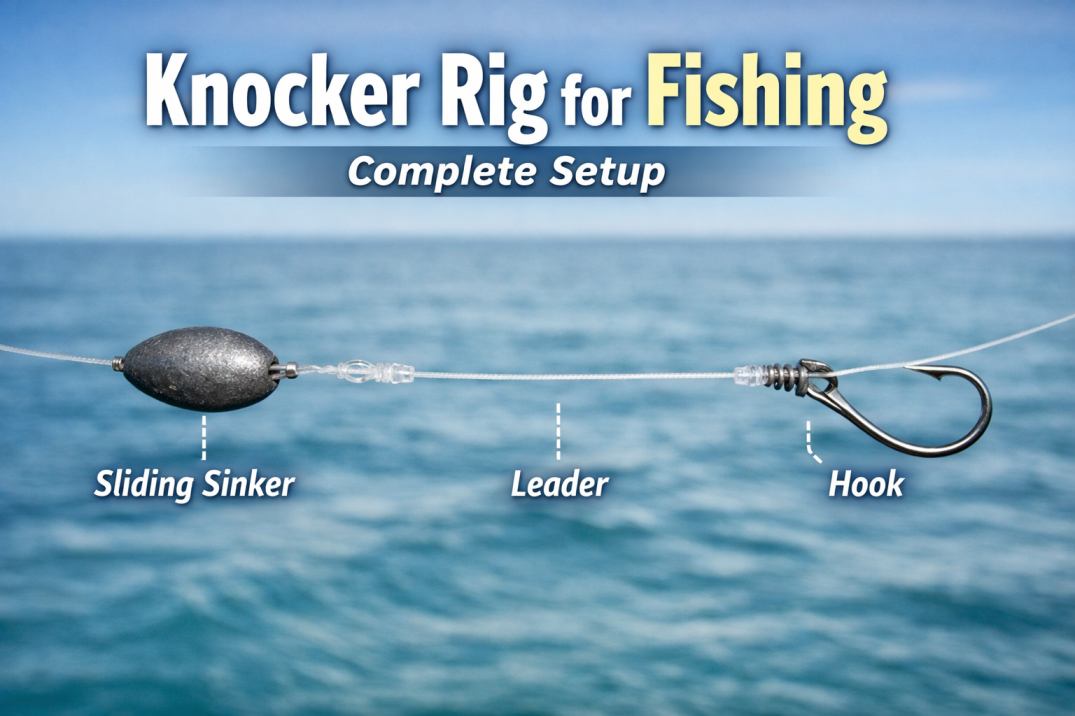
When I first heard about the Knocker Rig for fishing, to be honest, I thought, “What kind of rig is that?” I figured it was just another basic bottom rig with a fancy name. But after seeing how effective it is, especially in strong currents and around structure, I understood why so many experienced anglers rely on it.
The Knocker Rig is incredibly simple and easy to use, yet it’s a remarkably effective rig. The reason is simple: when fish are hugging the bottom, this rig keeps your bait right where it needs to be. What more could you ask for?
In this post, we’ll discuss what the Knocker Rig is, how to set it up correctly, and which fish species it works best for—all based on real-world fishing situations, not just theory.
What you’ll get in this post 🎣
- 🎣 What is a knocker rig, and why do anglers use it
- 🪢 Step-by-step knocker rig setup (easy to follow)
- ⚖️ When a knocker rig beats other bottom rigs
- ⚓ Best sinker weight, leader length, and hook size
- 🌊 Knocker rig for surf fishing, snapper, grouper, redfish, and catfish
- 🚫 Common mistakes that reduce bites
What Is a Knocker Rig for Fishing?
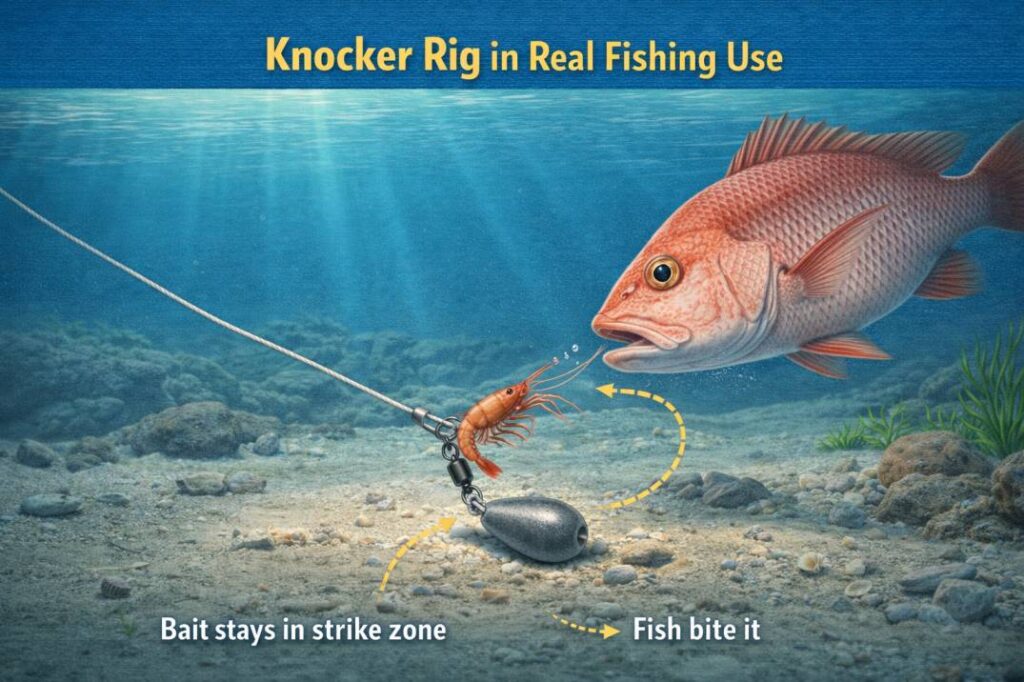
You’ve probably already guessed how it works from its name, the Knocker Rig. Let’s understand it in detail. The Knocker Rig is a bottom-fishing rig where the sinker slides directly down the leader and rests right against the hook or hook knot. Because the weight is positioned directly above the bait, it keeps everything tight, compact, and close to the seabed.
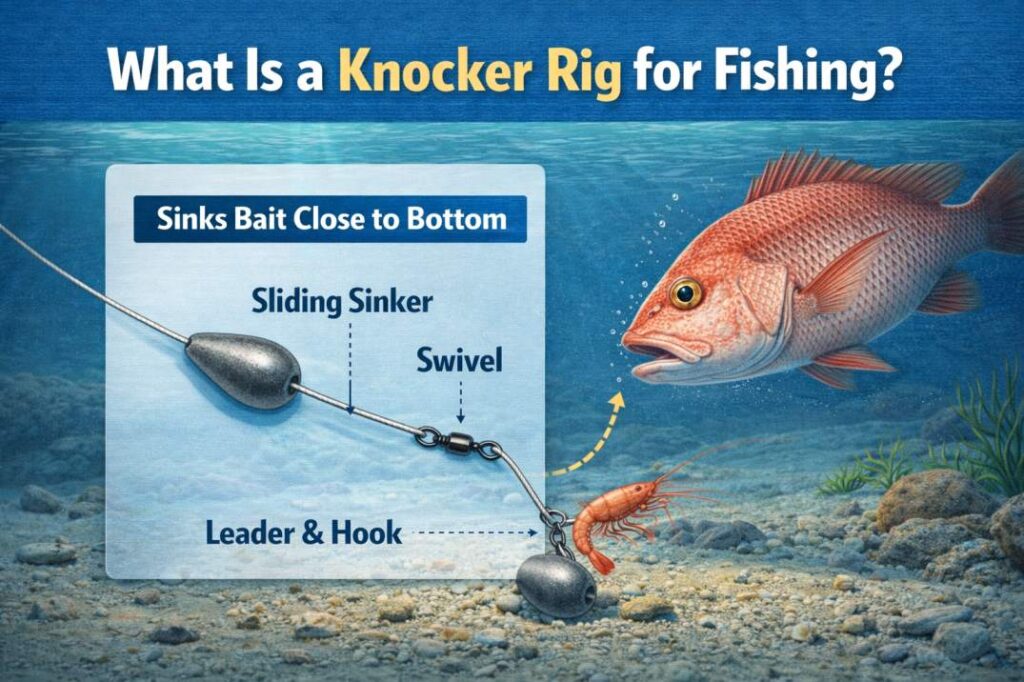
Unlike rigs with a long leader or a swivel above the weight, the Knocker Rig allows your bait to move naturally while remaining in the strike zone. Because the weight keeps it stable, it’s very effective in strong currents or deep water.
This simple design is why Knocker Rig fishing is so popular for reef and structure-dwelling fish.
Why Anglers Use a Knocker Rig
The knocker rig is very popular among anglers for its precision in targeting fish. Here are some reasons why anglers prefer this rig:
- The bait stays close to the bottom, right in the fish’s feeding zone.
- The rig offers excellent sensitivity, allowing you to detect bites instantly.
- The line remains taut even in strong currents.
- It’s ideal for vertical or near-vertical fishing.
- Due to its vertical orientation, this rig is less prone to tangling compared to rigs with longer leaders.
The knocker rig is particularly useful when fish are holding close to structure or feeding near rocks, reefs, or shipwrecks.
Send feedback
Knocker Rig Setup (Step-by-Step Guide)
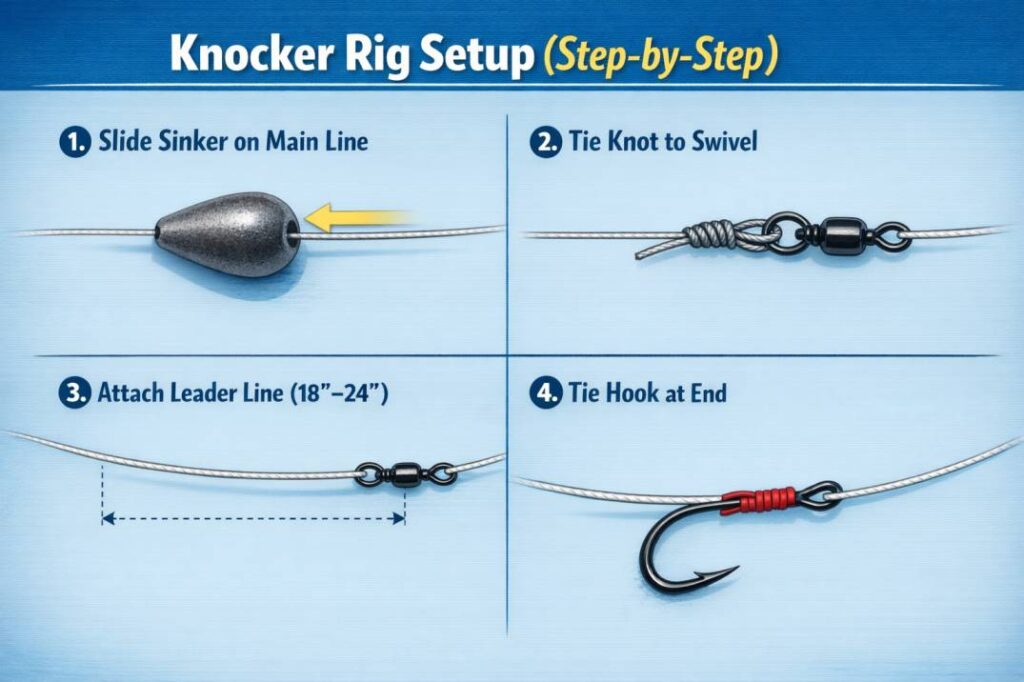
It’s important to understand this section because many anglers set up their rigs incorrectly. This results in less successful fishing.
What you need for the rig setup:
- Sliding egg sinker or bullet sinker
- Leader line (fluorocarbon leader line is better)
- Circle hook or J-hook
- Mainline (braided or monofilament)
Step-by-Step Knocker Rig Setup:
You can easily do this. Just follow these four steps carefully.
- Slide the sinker onto your mainline.
The sinker should slide easily on the line so the fish can take the bait naturally. - Now tie your mainline to the leader.
Use a strong knot like a Uni-to-Uni or FG knot. - Choose the correct leader length.
Most knocker rigs use a 12–24 inch leader. - Tie the hook to the end of the leader.
After tying, the sinker should slide down and rest right against the hook knot—this is why it’s called a “knocker” rig.
That’s it! Simple, clean, and effective.
Best Sinker Weight for a Knocker Rig
Sinker weight depends on the situation, such as depth and current.
| Water Depth | Weight of Sinker |
| Shallow/calm | 1–2 oz |
| Moderate current | 3–5 oz |
| Deep water / strong current | 6–10 oz |
The goal is just enough weight to stay on the bottom, not more.
Best Leader Length and Hook Size
- Leader length: 12–18 inches (most situations)
- Hook size:
- Small snapper/ panfish: 1/0–2/0
- Redfish/ catfish: 3/0–5/0
- Grouper / big snapper: 6/0–8/0
Circle hooks are strongly recommended, especially for reef fish.
Knocker Rig vs Fish Finder Rig
Many anglers ask about the difference between these two rigs.
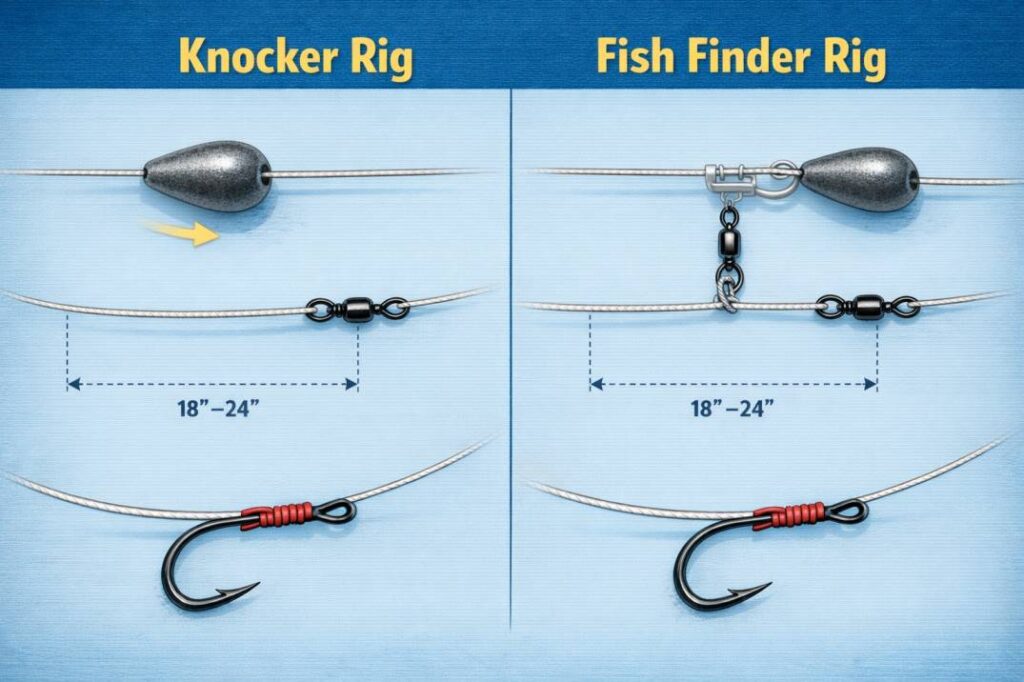
Knocker rig: This rig is the best vertical fishing rig; it is compact and provides direct contact with the bait. It relates to the bottom-feeding zone.
Fish finder rig: This rig is better for sandy bottoms, with longer leader length and very free bait movement.
If fish are tight to structure or the current is strong, the knocker rig usually wins.
Knocker Rig for Surf Fishing
The knocker rig can be effective if you assess the conditions correctly, but only in specific situations.
Use it when:
- You are fishing in holes near the shore.
- The current is not strong.
- You want to detect bites quickly.
For strong currents, a fish finder or a high-low rig might be better, but in calm conditions, the knocker rig can surprise you.
Best Fish Species for a Knocker Rig
Knocker Rig for Redfish
This works well around docks, channels, and structures. Use a medium-weight sinker (3–5 oz) and cut bait or live shrimp.
Knocker Rig for Snapper Fishing
The knocker rig is one of the best rigs for snapper. This rig keeps the bait right where snapper feed—near rocks and structures. It places the bait directly in the snapper’s feeding zone.
Knocker Rig for Red Snapper
For red snapper:
- 4–6 feet deep zones
- Strong leader (40–60 lb)
- Circle hooks are essential
This rig keeps your bait visible and natural-looking.
Knocker Rig for Grouper
The knocker rig truly shines when grouper fishing. Let us understand how to setup rig for the grouper.
- Heavy leader (60–80 lb)
- Large hooks
- Heavy sinker
The compact setup helps pull the grouper away from the structure quickly.
Knocker Rig for Catfish
Surprisingly, this is very effective in rivers and channels.
It’s especially good when fishing in areas where catfish are holding near the bottom.
When NOT to Use a Knocker Rig
Avoid using this rig in the following situations:
- Do not use this rig if you are fishing in areas with a lot of snags.
- It will not provide stability in strong currents or rough seas.
- Using this rig is pointless if the fish are feeding in the middle of the water column, as it targets the bottom-feeding zone.
- Avoid this rig if you need to cast your bait a long distance.
Knowing when not to use it is just as important as knowing when to use it.
Common Knocker Rig Mistakes
These are very common mistakes you should avoid. These mistakes can occur due to our attempts to do something different.
- Using an excessively long leader
- An overweight sinker will reduce the effectiveness of the rig
- Tying poor knots
- When using the wrong hook size for the target fish, you need to understand which fish are bottom feeders.
Correcting these small problems can double your catch rate.
FAQs
❓ What is a knocker rig used for?
A knocker rig is used for bottom fishing when fish are holding close to the seabed or structure like reefs and rocks.
❓ Is a knocker rig better than a fish finder rig?
A knocker rig works better in current and vertical fishing, while a fish finder rig is better for sandy bottoms and more bait movement.
❓ What is the best leader length for a knocker rig?
Most anglers use a leader between 12 and 18 inches for better control and fewer tangles.
❓ Can you use a knocker rig for surf fishing?
Yes, a knocker rig can work in calm surf conditions when fish are feeding close to shore.
❓ What fish can you catch with a knocker rig?
A knocker rig is commonly used for snapper, grouper, redfish, and catfish.
Final Thoughts
The knocker rig for fishing is one of those setups that looks too simple to work until you use it correctly. Whether you’re targeting snapper, grouper, redfish, or even catfish, this rig earns its place in any angler’s tackle box.
Used knocker rig in the right conditions, it’s efficient, sensitive, and extremely effective.
Was this guide helpful?
First-Hand Experience
Based on animals I've personally kept and bred - not summarized from other articles.
Zoological Foundation
Claims are checked against my M.Sc. Zoology training and published aquatic biology research, not recycled aquarium myths.
No Paid Influence
No sponsorship shaped this guide. Affiliate links, if any, are disclosed separately and never hidden.
Kept Current
Errors are corrected as soon as they're found, with the update noted at the bottom of the article.

Anil Satak M.Sc. Zoology · Founder, FishioHub
Grew up in a fishing family in India and holds a Master's in Zoology. FishioHub is a one-person operation - every guide is personally researched, kept-tested, and written by Anil. No team, no outsourced writers, no AI-generated content. Read his full bio →