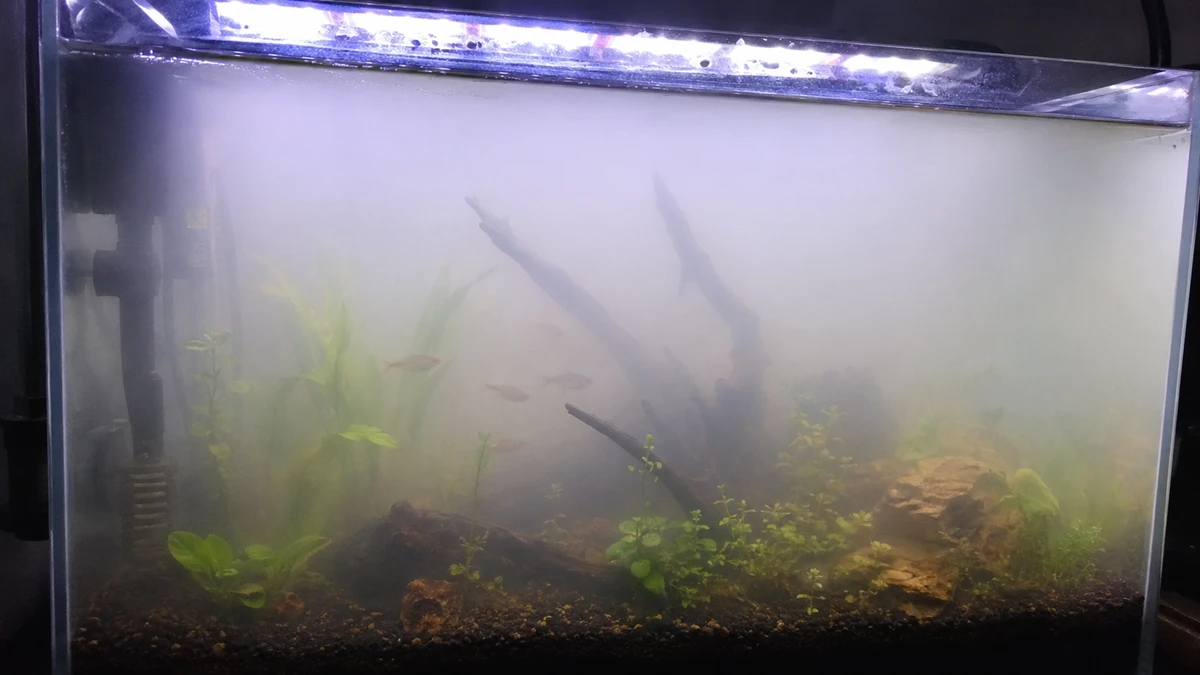
Why is my fish tank cloudy overnight? In most cases, it’s a bacterial bloom — a sudden spike in free-floating heterotrophic bacteria feeding on excess ammonia from overfeeding, a new setup, or a disturbed filter. It’s rarely dangerous and typically clears within 24–72 hours on its own.
I panicked when my tank turned milky white overnight; an immediate test revealed that nitrite levels had spiked due to a rotting zucchini hidden behind the driftwood. The tank was in such a terrible state that, out of sheer frustration, I was even considering throwing it out of the house.
Heterotrophic bacteria — the kind responsible for almost every overnight bloom — can double their population in as little as 20 minutes under the right conditions. Compare that to the nitrifying bacteria your filter depends on in the long term, which take 7 to 20+ hours to double. That gap in reproduction speed is the entire reason a tank can look clear at bedtime and like diluted milk by morning: one group of bacteria is racing, the other is still walking.
That’s the zoology behind it. Now let’s get your water clear.
What You’ll Get in This Post
- 🌫️ Why your fish tank is cloudy overnight and which of 7 causes is yours
- 🥛 The 30-second white-cup test to tell white, green, and brown cloudiness apart
- 🔬 What actually causes cloudy aquarium water at the bacterial level (not just “bad water”)
- 🛠️ A step-by-step guide to how to fix cloudy aquarium water without wrecking your cycle
- ⚡ The fastest way to clear cloudy aquarium water when you need results today
- 🇺🇸 A USA buyer’s note on test kits and conditioners worth the money
- 💡 Expert prevention tips so this doesn’t happen again next month
First: What Kind of Cloudy Is It? (The White-Cup Test)
Before you fix anything, find out what you’re actually looking at. Scoop a cup of tank water into a white mug or bowl and hold it up to a window.
- Milky white or gray, no visible specks → bacterial bloom (by far the most common overnight cause)
- Green, like diluted pea soup → algae bloom (Euglena and similar free-floating algae)
- Yellow or tea-colored, water is clear, not cloudy → tannins from driftwood or decaying plant matter, not true cloudiness
- White with visible floating specks that settle → disturbed substrate or dust, not bacteria
This one test rules out three of the seven causes below before you touch anything in the tank.
Why Is My Fish Tank Cloudy Overnight? 7 Real Causes
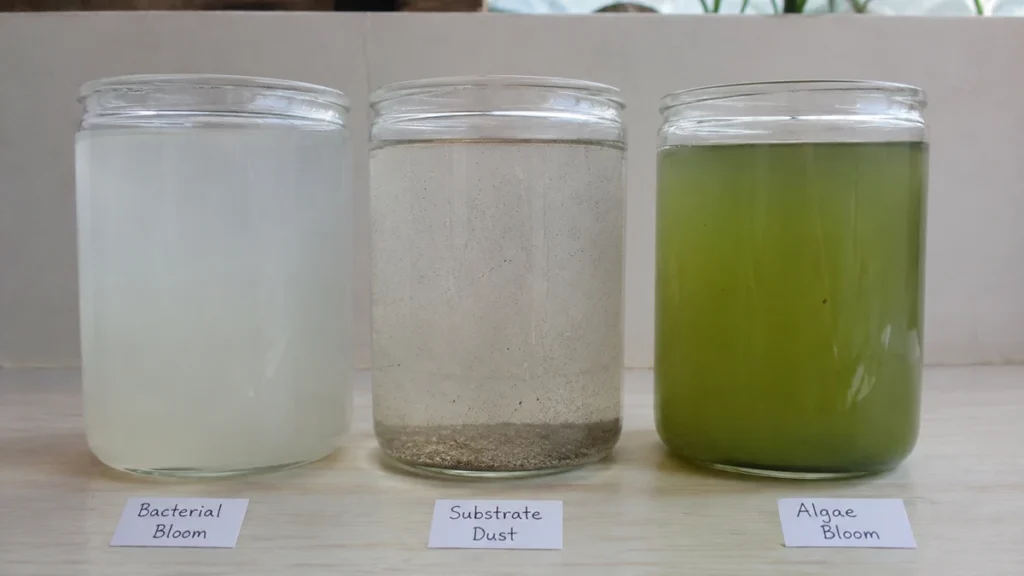
1. Bacterial Bloom (The Most Common Cause)
A sudden spike in free-floating heterotrophic bacteria turns the water milky white. This is the cause behind the vast majority of “it was fine yesterday” messages I get.
It happens when:
- New fish were added recently, spiking the bioload
- The filter was cleaned too aggressively
- Leftover food or waste increased faster than the bacteria colony could process it
- Substrate was stirred during cleaning
- The tank is new and still cycling
These bacteria are not harmful to fish. As the colony stabilizes, cloudiness clears within 24–72 hours without intervention.
2. Overfeeding & Waste Build-Up (Your Biggest Mistake)
Uneaten food decomposes fast and releases ammonia, and ammonia is the fuel that starts a bacterial bloom in the first place.
Watch for:
- Food is sinking and rotting instead of getting eaten
- Fish ignoring flakes or pellets they used to go after
- A faint sulfur or “swamp” smell near the tank
Fix: feed once daily, only what fish clear in 2 minutes, and siphon out anything left after 5 minutes.
3. Disturbed Substrate
Vacuuming gravel, moving decorations, or planting stems releases fine particles into the water column. This is physical, not biological — the filter traps most of it within 24 hours.
4. New Tank Syndrome
In a tank under roughly 4–6 weeks old, the nitrogen cycle hasn’t matured yet. Heterotrophic bacteria (fast) outrun the nitrifying bacteria (slow) every time, and cloudiness comes and goes for the first 1–3 weeks as a normal part of cycling — not a sign anything’s wrong.
A rough timeline for a fishless or lightly stocked cycle: cloudiness typically peaks in week 1, ammonia should start dropping by week 2 as the first bacteria colony establishes, and nitrite spikes (often invisible, since it doesn’t cloud the water) usually follow in week 2–3 before the second bacteria group catches up. If cloudiness is still showing up in week 5 or 6, something else on this list — usually overfeeding — is adding fuel on top of the normal cycle.
5. Unwashed Gravel or Decorations
New gravel, sand, or ornaments carry manufacturing dust that clouds the water immediately on contact.
Fix: rinse substrate under running water until it runs clear before it goes anywhere near the tank.
6. Overcleaning the Filter
This one causes the exact problem it’s meant to prevent. Rinsing filter media in tap water, replacing cartridges too often, or deep-cleaning everything at once strips out the nitrifying bacteria colonies living on the media — and the tank blooms trying to rebuild them.
Fix: rinse media in old tank water, never tap water, and only replace it when it’s physically falling apart.
7. Algae Bloom (Green Water)
Less common overnight but it does happen — usually after a lighting change. Free-floating algae like Euglena reproduce fast under too much light (over 8–10 hours a day, direct sunlight, or non-aquarium bulbs) combined with excess nutrients from overfeeding or overstocking.
Fix: cut light to 6–8 hours, block direct sunlight, and reduce feeding. Green water needs light control, not a bigger water change — water changes alone barely touch it.
Why This Happens Overnight Specifically
People rarely notice cloudiness building during the day — tank lights are on, you’re glancing at it in passing, and low-grade haze is easy to miss against reflections on the glass. Overnight, the lights go off, the house goes quiet, and a bloom that’s been building for 12–18 hours suddenly stands out against a dark room.
There’s also a biological reason it compounds after dark. Photosynthetic plants and algae stop producing oxygen once lights go off, so dissolved oxygen in the tank dips overnight anyway — right as a bacterial bloom is also consuming oxygen to break down waste. That’s the exact reason gasping at the surface, if you see it, is the one sign that turns “wait it out” into “test now.”
Should You Change the Water When It’s Cloudy?
Usually no — unless ammonia or nitrite tests above 0 ppm.
Here’s the part that trips people up: a bacterial bloom is the tank actively fixing itself. A big water change removes the bacteria doing that work, so cloudiness often returns worse a day or two later. Test first, then decide:
- Ammonia > 0 ppm or Nitrite > 0 ppm → do a 25–30% water change
- Both read 0 → leave it alone and let the bacteria finish stabilizing
How to Fix Cloudy Tank Water Overnight (4 Steps)
Step 1: Stop Feeding for 24 Hours
Healthy fish can comfortably skip a full day of food. This single step removes the fuel source for most overnight blooms without you touching anything else.
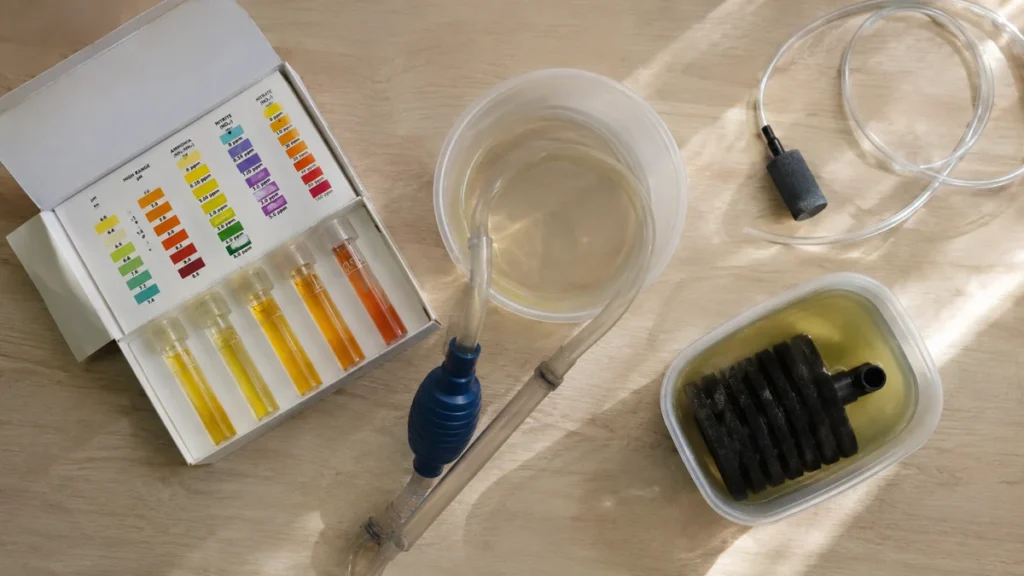
Step 2: Test Ammonia, Nitrite & Nitrate
Use a liquid test kit, not strips — strips are notoriously imprecise on ammonia specifically. If ammonia or nitrite reads above 0:
- Do a 25–30% water change
- Optionally add a bottled bacteria supplement to speed re-colonization
- Hold off on feeding at normal levels for about a week
Step 3: Clean the Filter — Carefully
Rinse media in a bucket of removed tank water only. Tap water contains chlorine or chloramine that kills the exact bacteria you’re trying to protect.
Step 4: Improve Aeration
More dissolved oxygen speeds up how fast beneficial bacteria can process waste. Add an air stone, increase surface agitation, or bump filter flow slightly until the bloom clears.
First 24 Hours: What To Actually Do (In Order)
If you want a simple checklist instead of reading through the causes:
- Run the white-cup test to confirm it’s a bacterial bloom and not algae or particulate
- Stop feeding immediately
- Test ammonia and nitrite with a liquid kit
- If both read 0 ppm, do nothing further — just wait 24–72 hours
- If either reads above 0, do a 25–30% water change and retest in 24 hours
- Add an air stone if you have one lying around; oxygen speeds recovery
- Do not touch the filter beyond a gentle rinse in old tank water
- Recheck water clarity and ammonia at the 48-hour mark
USA Buyer’s Note: What’s Actually Worth Buying
Most cloudy-water fixes need zero new purchases. If you don’t already have a liquid test kit, the API Freshwater Master Test Kit is the one most US fish stores (Petco, PetSmart, independent LFS) stock, and it typically runs $25–35 — cheaper per test than strips over time and far more accurate for ammonia. A basic air stone and check valve kit runs $5–10. Bottled bacteria supplements (Seachem Stability, API Quick Start) run $8–15 and are optional, not required — the bacteria you already have will recolonize on their own given time.
When Cloudy Water Actually Means Trouble
Cloudy water on its own is rarely an emergency. What turns it into one is a combination of fish behavior changes. Watch for:
- Fish clustered at the surface gasping — usually oxygen depletion, not the cloudiness itself
- Clamped fins or hiding that wasn’t there yesterday
- Loss of appetite lasting more than a day
- Red or inflamed gills visible up close
Any of these alongside cloudy water means test ammonia and nitrite immediately rather than waiting out the usual 24–72 hours. None of them present is a good sign that this is an ordinary bloom running its course.
Science vs. Hobbyist Myth: “Nitrobacter Clears Your Water”
Here’s a correction worth making, because it’s repeated on almost every aquarium forum. For decades, hobbyist literature credited a bacterium called Nitrobacter with the second stage of the nitrogen cycle — converting nitrite into nitrate. Research published in Applied and Environmental Microbiology by Hovanec and colleagues found that freshwater aquarium filters are actually dominated by Nitrospira-like bacteria, not Nitrobacter, at that stage. It doesn’t change what you do in your tank, but it matters if you’re shopping for a bottled bacteria product — some older formulations were cultured around the wrong species entirely, which is part of why “instant cycling” bottles have such a mixed track record in the hobby.
Fastest Way to Clear Cloudy Aquarium Water (Quick Tips)
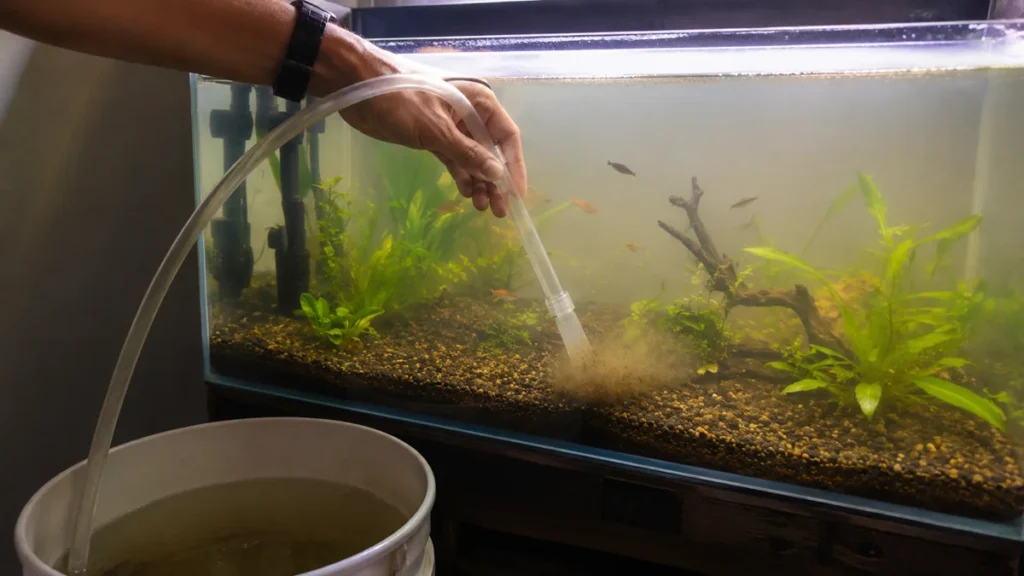
If you need results today rather than a full explanation:
- Change 20–30% of the water — only after testing ammonia/nitrite
- Remove visible debris and uneaten food with a siphon
- Skip feeding for 24 hours
- Confirm filtration is running at full flow, not clogged
These four together typically visibly improve clarity within a day, even though full clearing still takes 24–72 hours.
💡 Expert Tips to Prevent Cloudy Water Long-Term
- Feed amounts fish finish in 2–3 minutes, not what looks generous
- Never clean the filter, gravel, and decorations all in the same session — stagger it
- Leave filter media alone unless it’s physically disintegrating
- Stick to a weekly 20–30% water change and gravel siphon
- Always dose a water conditioner when adding new water
- Cap lighting at 6–8 hours a day and keep tanks out of direct sun
Cloudy water is a symptom, not the disease — ignore it repeatedly and ammonia spikes or an algae takeover are usually what’s coming next.
- 👉 Related: 20 Common Aquarium Problems And How to Fix Them — if cloudy water is one of several issues you’re noticing, this covers the full list.
- 👉 Related: Can Ghost Shrimp Live With Betta Fish? (Complete Compatibility Guide)
Scientific resources to read:
- Hovanec, T.A., Taylor, L.T., Blakis, A., & DeLong, E.F. (1998). Nitrospira-like bacteria associated with nitrite oxidation in freshwater aquaria. Applied and Environmental Microbiology, 64(1), 258–264.
https://journals.asm.org/doi/10.1128/aem.64.1.258-264.1998 - Burrell, P.C., Phalen, C.M., & Hovanec, T.A. (2001). Identification of bacteria responsible for ammonia oxidation in freshwater aquaria. Applied and Environmental Microbiology, 67(12), 5791–5800.
https://journals.asm.org/doi/full/10.1128/aem.67.12.5791-5800.2001
FAQs
What causes cloudy aquarium water?
What causes cloudy aquarium water almost always traces back to one of three things: a bacterial bloom from excess ammonia, disturbed substrate settling out, or an algae bloom from too much light. Identify which one with the white-cup test before treating it.
Why is my aquarium water cloudy white?
Why is my aquarium water cloudy white comes down to a bacterial bloom in nearly every case — beneficial bacteria multiplying rapidly in response to a new tank, overfeeding, or a disrupted filter. It looks alarming but is rarely dangerous.
Why does aquarium water become cloudy overnight specifically?
Aquarium water becomes cloudy overnight because heterotrophic bacteria can double every 20 minutes, far faster than the slower nitrifying bacteria that stabilize a tank. A trigger during the day can snowball into visible cloudiness by morning.
How do I fix cloudy aquarium water?
To fix cloudy aquarium water, stop feeding for 24 hours, test ammonia and nitrite, and only change water if either reads above 0 ppm. Let the bacteria stabilize naturally; otherwise, it usually clears within 24–72 hours.
How do I fix cloudy water in a fish tank naturally?
To fix cloudy water in a fish tank naturally, add live plants to compete with algae and bacteria for nutrients, avoid chemical clarifiers, and let your filter and bacteria colony do the work over 2–3 days.
What’s the fastest way to clear cloudy aquarium water?
The fastest way to clear cloudy aquarium water is a 20–30% water change combined with stopping feeding and confirming full filter flow — but only after testing shows that ammonia and nitrite are both at safe levels.
Why is my fish tank cloudy after I cleaned it?
A fish tank that’s cloudy after cleaning usually means the filter or gravel was overcleaned, stripping out beneficial bacteria that the tank now has to rebuild — the cloudiness is that rebuild in progress.
How long does cloudy fish tank water take to clear?
Cloudy fish tank water typically clears in 24–72 hours for a bacterial bloom, up to 1–3 weeks for new tank syndrome, and 7–10 days for a green algae bloom once light is reduced.
Bottom Line: Why Is My Fish Tank Cloudy Overnight?
Cloudy water overnight is one of the most common beginner scares in the hobby, and in the vast majority of cases, it resolves itself within a couple of days without any dramatic intervention. Run the white-cup test, skip feeding for a day, test your ammonia, and resist the urge to deep-clean everything at once.
If cloudiness persists past 4–5 days, or fish show stress (gasping at the surface, clamped fins, lethargy), stop waiting and test for an ammonia spike or check for a decaying object you might have missed.
Was this guide helpful?
First-Hand Experience
Based on animals I've personally kept and bred - not summarized from other articles.
Zoological Foundation
Claims are checked against my M.Sc. Zoology training and published aquatic biology research, not recycled aquarium myths.
No Paid Influence
No sponsorship shaped this guide. Affiliate links, if any, are disclosed separately and never hidden.
Kept Current
Errors are corrected as soon as they're found, with the update noted at the bottom of the article.
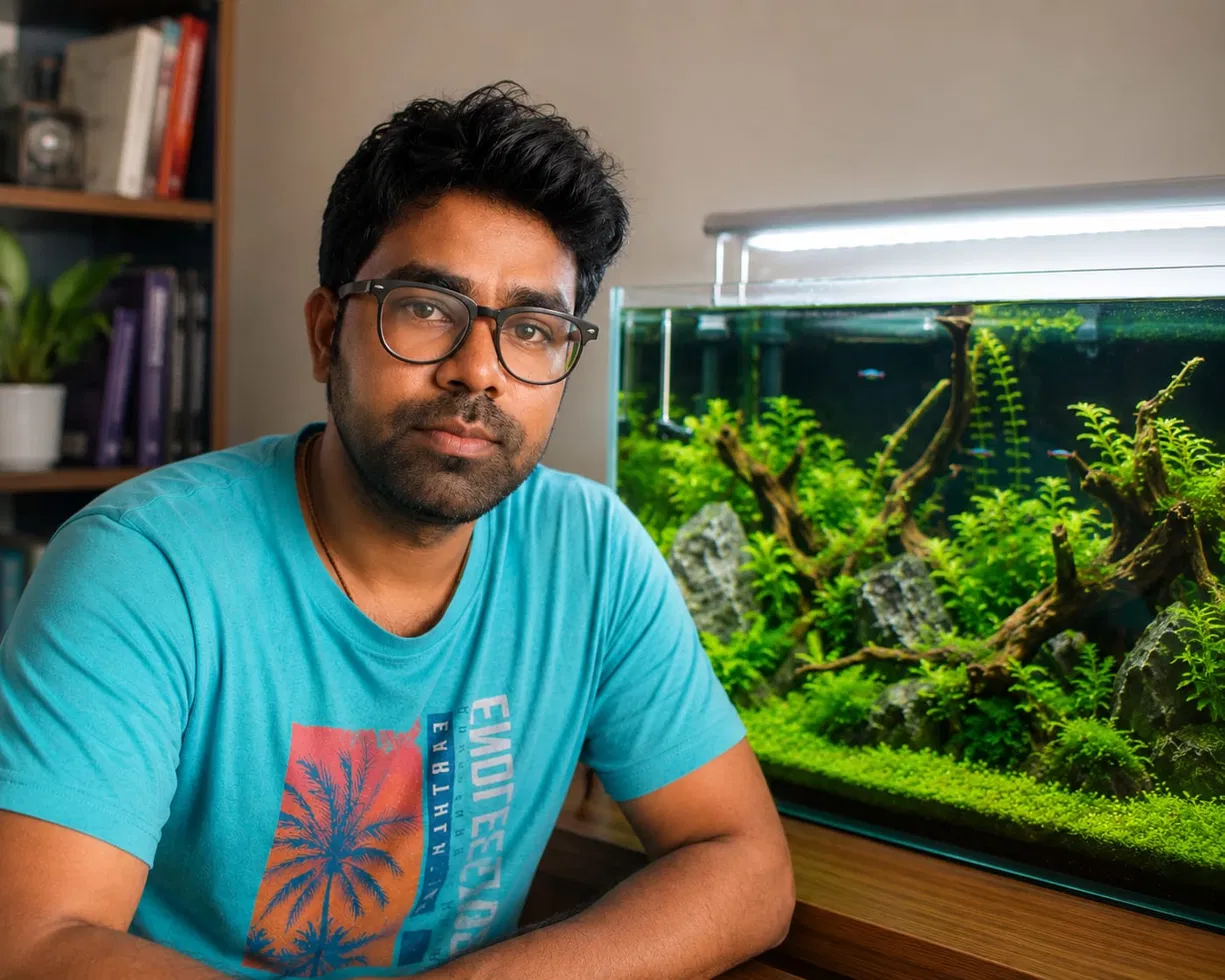
Anil Satak M.Sc. Zoology · Founder, FishioHub
Grew up in a fishing family in India and holds a Master's in Zoology. FishioHub is a one-person operation - every guide is personally researched, kept-tested, and written by Anil. No team, no outsourced writers, no AI-generated content. Read his full bio →